
Comprehensive Guide to Copywriting: 2026 Update

Key Takeaways
- Copywriting is persuasive writing designed to drive a specific action. It differs from content writing, which builds awareness over time.
- Good copy starts with a deep understanding of your audience’s pain points. It goes deeper than just listing your product’s features.
- AI can assist with drafting and scaling copy, but human strategy and judgment are what make it convert.
- Craft fundamentals like tone and storytelling remain the backbone of effective copy.
- Copy that demonstrates genuine expertise and cites original data is more likely to show up in AI visibility.
AI can write copy in seconds. So why does human-generated content still pull in 5.44 times more traffic than AI-generated content?
Copywriting is about getting people to act. That’s a skill that still demands a human touch.
Copywriting is different from content writing. Whereas content writing builds awareness over time, copywriting is built for one thing: conversions. Every word is focused on driving visitors to sign up or buy.
That distinction matters more than ever as AI floods the internet with generic output every day. The brands that cut through the noise are the ones treating AI like a tool, using it strategically to craft copy that speaks to real human motivations.
This guide covers what copywriting is, why it still matters in 2026, and which strategies work.
What Is Copywriting?
Copywriting is the practice of writing persuasive text to get readers to take a specific action, such as signing up for a newsletter or making a purchase. It includes everything from ads and landing pages to emails and product descriptions.
Good copy communicates your value clearly and motivates the reader to act. Features, benefits, pricing, and social proof all serve the message, but copy is what determines how those elements land with the reader.
In other words, your product or service is the offer, and your copywriting is the pitch. No matter how strong the offer is, a weak pitch won’t convert your target audience.
How Does Copywriting Differ from Content Marketing?
Many people get tripped up by the difference between copywriting and content writing. Some use the terms interchangeably, but they serve different purposes.
Content writing is the craft behind content marketing. It focuses on indirect goals, such as educating your audience or building brand awareness. Assets like blog posts and webinars fall into this category. Their aim is to bring readers in and keep them coming back.
Copywriting is more direct. Its job is to get the reader to take a specific action, right now. You see it in ads, calls to action (CTAs), and product descriptions, but it shows up everywhere decisions get made.
My own blog is a good example of both working together. The article you’re reading right now is content marketing. Its goal is to inform you about copywriting.
However, the page also contains distinct copy elements, each doing a specific job:
- The headline, “Comprehensive Guide to Copywriting: 2026 Update,” gets you to click.
- The banner ad above drives traffic to our Ads Grader.
- The CTA below, which also shows up in the sidebar of my site, nudges you to get a free SEO analysis and potentially work with our agency.
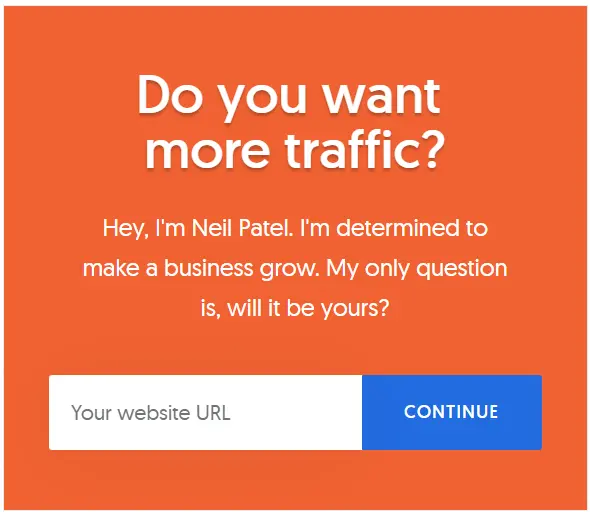
All appear on the same page, but each has a different objective.
Is Copywriting Still Important?
AI can generate copy at scale. So, the question many marketers are asking right now is: Do you even need a human copywriter anymore?
The short answer is yes. Here’s why.
Copywriting has always been about more than stringing words together. It’s about understanding what motivates your audience and building a message that moves them to act. AI can draft and iterate quickly, but it can’t replace the strategic thinking that makes copy convert.
There’s also a trust problem. According to Accenture’s Life Trends report, 62 percent of consumers say trust is an important factor when choosing to engage with a brand.
At the same time, AI-generated content is flooding every channel. Audiences are getting better at spotting generic copy and tuning it out, and their eyes are sharpening quickly. Data from CivicScience shows 36 percent of consumers can spot AI in a brand’s marketing and won’t do business with them when they do. That number has gone up 4 percent in less than six months.
This data illustrates exactly why copywriting is so important. A well-crafted headline or an email that sounds human still requires a writer who understands the nuance behind the words.
AI is a powerful tool in the writing process, but the judgment and the strategy behind effective copy still require a person. Neglecting that human element means you could be missing out on over five times as much traffic, as we mentioned in the intro to this guide.
Types of Copywriting
Copywriting strategies vary depending on your goals. Here’s a look at how brands can apply each of the types of copywriting.
Brand Copywriting
Brand copywriting defines how a brand displays its values and personality, creating an emotional connection with its customers. It shows up in landing pages and anywhere else a brand needs to interact with its audience.
Many people picture brand copywriting as the big, flashy stuff, like what you see in Pepsi commercials and on Nike billboards. Those are some of the most visible examples, but the goal is the same no matter the scale: to create an emotional connection with your audience.
That connection drives real business results. Analysis of over 1,400 advertising case studies in the Institute of Practitioners in Advertising (IPA) dataBANK finds that purely emotional campaigns outperform those using rational content alone, generating almost double the profitability.
Take the ad below from Apple as an example. It doesn’t mention product specs or features. It’s designed to make the viewer feel they’re getting the coolest products with the best technology when they buy from Apple.

Brand copywriting is about making people emotionally connected to your brand. Done well, it turns a transaction into a lasting relationship.
Social Media Copywriting
Social media copywriting is about grabbing users’ attention as they scroll and then converting it. Every platform has its own rules, so your approach needs to adapt accordingly. Copy that works on LinkedIn, for example, won’t land the same way on X or TikTok.
That said, the goal’s the same across platforms: to get people to act. Recent data shows 89 percent of consumers say a brand’s social media impacts their purchasing decisions. That kind of conversion requires copy that’s platform-native and strongly guides viewers to a clear CTA.
While there are some nuances to creating native copy, here are a few principles that apply across channels:
- Use strong, active verbs and keep sentences short.
- Write in a tone that feels human, not corporate.
- Lead with your hook and always include a clear CTA.
- Mix it up. Rotate between educational, entertaining, and conversational content.
- Use hashtags strategically to extend your reach
SEO Copywriting
SEO copywriting is the practice of writing content that ranks well in search engines and provides value to the reader. It’s about creating copy that satisfies search intent and compels the right audience to take action.
For years, the formula was straightforward: Research keywords and build high-quality content around them. That formula still holds, but the game has changed.
AI is now answering questions directly on the search engine results page (SERP), which means traffic that once flowed to well-ranked content is shrinking.
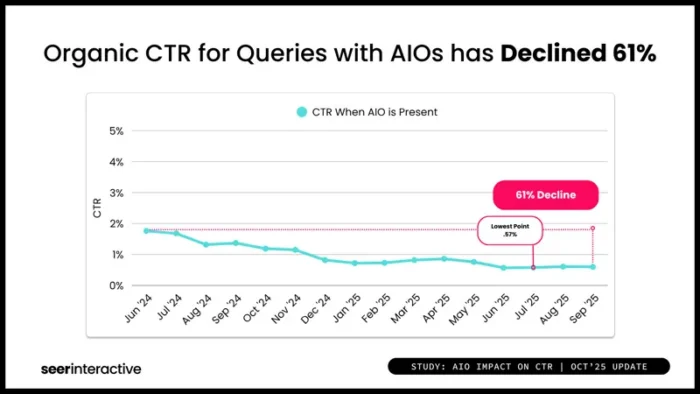
Recent data shows that the organic click-through rate (CTR) for queries featuring Google AI Overviews has dropped 61 percent (as seen in the graph below). Users are getting the information they need quickly and moving on without clicking through to your site.
Source: https://www.seerinteractive.com/insights/aio-impact-on-google-ctr-september-2025-update
The right response is to make your SEO copywriting better.
Copy that answers questions with depth and specificity, earning citations in AI Overviews, will outperform generic, keyword-stuffed content. According to the same study, websites cited in AI Overviews are seeing a 35 percent higher organic CTR than those without citations.
Thought Leadership Copywriting
Thought leadership copywriting positions your brand as a trusted authority in your industry. The goal is to deliver expert perspectives and original thinking that earns credibility with the people who matter most.
My team and I already implement this strategy through thought leadership pieces like this one on social ranking strategies from our Digital PR Director, Kimberly Deese:
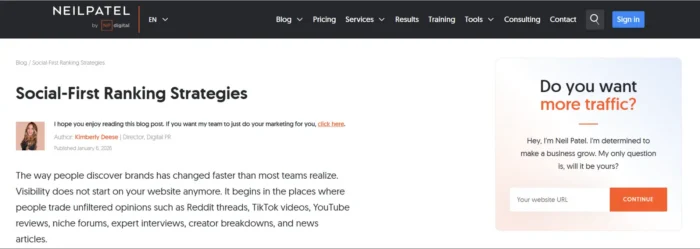
This approach works well with experienced, senior audiences.
According to the recent Edelman-LinkedIn B2B Thought Leadership Impact Report, the majority of decision-makers and C-suite executives spend an hour or more each week consuming thought leadership content. And 73 percent say an organization’s thought leadership is one of the best ways to evaluate the caliber of work it’s likely to deliver to clients.
Thought leadership content takes many forms: expert interviews, research reports, essays, podcasts, and branded publications.
Nutanix is a strong example. Its online magazine, The Forecast, takes a broad look at enterprise cloud computing through expert content, and builds authority without ever leading with a product pitch.

Email Copywriting
Email copywriting is one of the most direct forms of copy you’ll write. You’re landing in someone’s personal inbox, and you have seconds to make an impression before they scroll past or hit delete.
The opportunity is worth the effort. Email marketing generates a higher return on investment (ROI) than virtually any other marketing channel, averaging $10 to $36 for every $1 spent.
What makes email copywriting distinct is the relationship it assumes. Unlike a social ad or a search result, an email speaks directly to someone who has already opted in. That trust needs to be respected.
Strong email copy starts with a subject line that earns opens and delivers value quickly, then asks the reader to take action with your CTA. Personalization and relevance are the baseline.
Tools for Copywriters
AI writing tools aren’t going away, and that’s a good thing for copywriters. They can sharpen your output when you use them strategically. Without applying your own judgment along the way, though, they can flatten it.
Here are four tools that can make your writing more efficient and impactful if you use them right.
1. Anyword
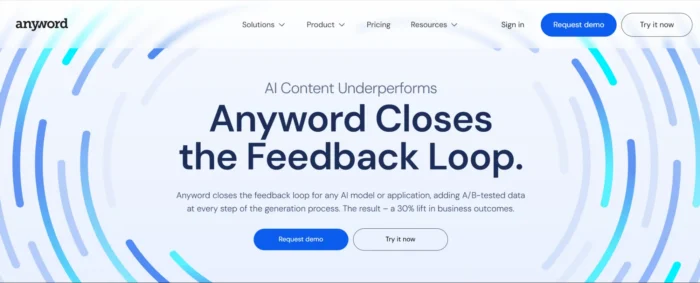
Anyword is a data-driven AI copywriting platform built specifically for marketers. Its standout feature is a predictive performance score that forecasts how well your copy will convert before you publish, based on a dataset of millions of real-world A/B-tested ad campaigns.
Anyword gives you multiple variations ranked by predicted performance. You pick the winner before spending a dollar on distribution.
It works best for performance-driven copy like paid ads. If you’re running campaigns where conversion rates directly impact revenue, Anyword’s ability to cut the guesswork makes it worth the investment.
2. Grammarly
Grammarly has been a popular copywriting tool for years. It integrates directly into the apps you already use, catching spelling and grammar mistakes and flagging tone mismatches.
In late 2025, Grammarly’s parent company rebranded to Superhuman, uniting Grammarly with productivity tools Coda and Superhuman Mail under one platform. The Grammarly writing tool itself remains unchanged. It’s just now part of a broader AI productivity suite that includes a new AI assistant called Superhuman Go.
For copywriters, the core value proposition hasn’t shifted. Grammarly is still one of the most reliable tools for catching errors and refining tone before your copy goes live.
3. Wordtune
Wordtune is an AI-powered rewriting tool built around one core idea: Your meaning is there, but the words aren’t landing yet. Paste in your copy, and Wordtune suggests alternative phrasings that preserve your meaning while improving clarity and flow.
Unlike tools focused on grammar correction, Wordtune is about expression. You can toggle between formal and casual tones and choose from multiple rewrite options for the same passage. It integrates directly into most major platforms, working wherever you write.
For copywriters, it’s most useful during the editing phase when you need to sharpen individual sentences without losing your voice. Think of it as a sounding board for your ideas.
4. Writesonic
Writesonic is a full-scale AI content platform built for marketers and content teams that need to produce high volumes of quality copy across multiple formats. Where tools like Wordtune focus on refining what you’ve already written, Writesonic is built for content generation.
Recently, the platform has grown beyond its content-generation engine roots to include SEO tools and AI visibility tracking, showing brands how they appear on platforms like ChatGPT and Perplexity. For copywriters working on search-driven content, that’s an advantage over tools that rely solely on static training data.
Writesonic is best suited for small or large teams that need to produce high-quality content and track its performance in today’s search everywhere environment.
As with any AI writing tool, of course, the output still requires human editing and strategic oversight, but it significantly reduces the time from a blank page to a working draft.
How to Copywrite: Copywriting Strategies
Tools can make you faster. Strategy is what makes you effective. Here are 10 basics of copywriting that turn good writing into copy that drives action.
1. Before You Start, Get to Know Your Audience
Great copy speaks directly to your reader. Before you write a word, you need a clear picture of who that person is.
According to Attentive’s Consumer Trends Report, 81 percent of consumers ignore irrelevant marketing messages. The fix is knowing your audience well enough that your copy never feels generic to them.
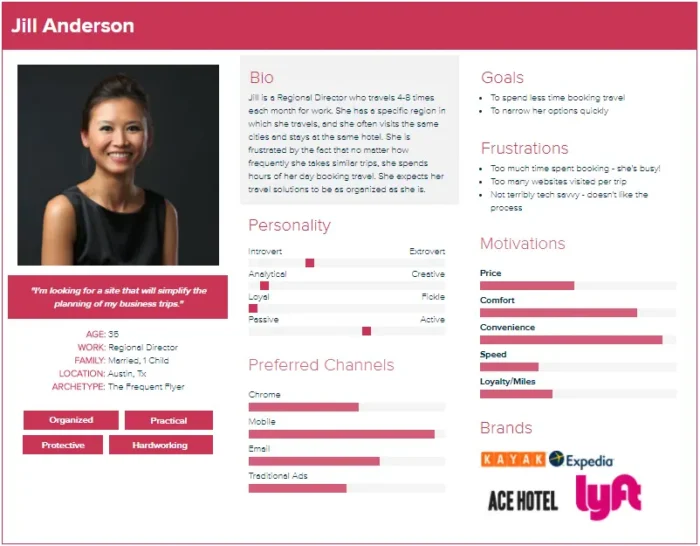
Start by building a buyer persona: a detailed profile of your ideal customer, like the one below. Pull from your actual customer data rather than assumptions. Look at who your highest-value customers are and what they have in common.
Source: https://xtensio.com/user-persona-template/
Once you have that profile, let it shape every copy decision. How does this person speak? What objections do they have to your brand? The more specifically you can answer those questions, the more directly your copy will speak to them.
Another simple tactic that works every time is writing to “you,” not “them.” Copy that addresses the reader directly, and not your audience as a group, converts better because it feels personal.
HubSpot proved this with a study of 330,000 CTAs over a six-month period. The resulting data showed that personalized CTAs performed 202 percent better than more generic CTA copy.
2. Use the Right Tone
Tone is what makes copy feel right or wrong for a given audience. It’s the attitude behind your words that signals whether your brand is playful, authoritative, empathetic, or direct. Get it wrong, and even accurate, well-written copy can push people away.
Consider two versions of copy for a fictional sales software company:
“Understand your customers better using state-of-the-art software designed to take your business from zero to hero.”
“Gain a deeper understanding of your customers using our AI-powered sales software. SellingPlus helps streamline your sales funnel and drive revenue.”
The first is approachable and slightly playful, a good fit for a scrappy startup audience. The second is polished and precise, better suited for a C-suite buyer evaluating enterprise solutions.
Using the right tone will resonate more with the person you identified in your buyer persona. When tone matches the audience, readers feel like the copy was written specifically for them.
3. Stress Your Unique Value Proposition (UVP)
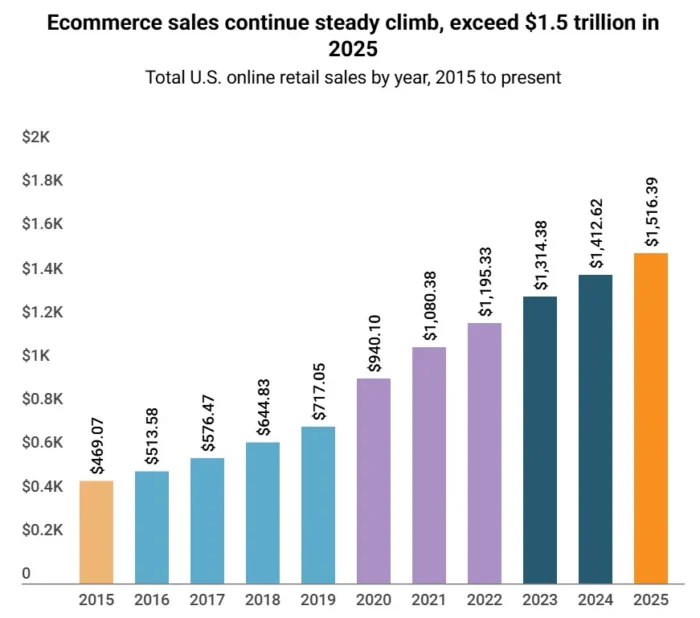
U.S. e-commerce sales exceeded $1.5 trillion in 2025, according to Digital Commerce 360’s data analysis.
Source: https://www.digitalcommerce360.com/article/us-ecommerce-sales/
In a market of that size, the brands that win are the ones that are crystal clear about what they offer that their competitors don’t.
That clarity is your unique value proposition (UVP): a concise statement of what you do and why you’re the right choice over the competition.
Strong UVP copy is specific. “We help small businesses manage their finances” is a generic example.
On the other hand, “Cloud accounting software built for small business owners who hate spreadsheets” tells someone exactly whether they’re in the right place.
Brands shouldn’t try to be perfect for everyone.
A small business owner shopping on a tight budget has different needs than an enterprise CFO. A free-range egg farmer needs different tools than a factory operation.
The more precisely your copy speaks to your actual audience, the more effectively it’ll convert. Stop trying to appeal to everyone and own your unique niche clearly.
4. Use Storytelling
“Facts tell, stories sell,” is one of the oldest sayings in sales and marketing, proving that storytelling is one of the most powerful tools in a copywriter’s toolkit.
A good story is more entertaining than a list of features and far more likely to be passed along. Most importantly, it puts the reader inside an experience rather than outside looking at a product.
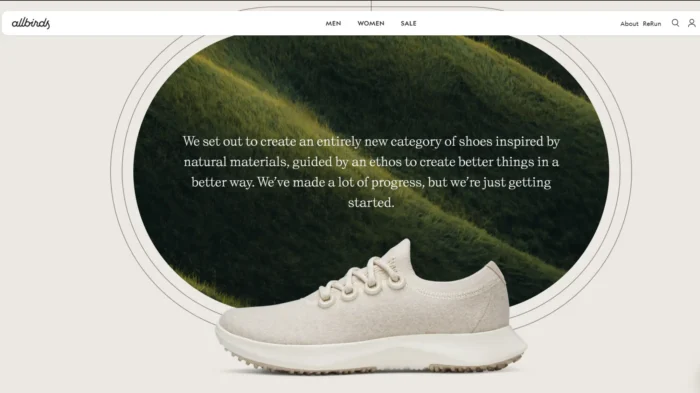
Allbirds does storytelling well. The footwear brand leads with a story about why its shoes exist, giving customers a sense of pride when buying from them. By the time you get to a product page, you’re already invested.
Source: https://www.allbirds.com/pages/our-story
You can see from the above example that you don’t need a lengthy origin story to use this approach. Even a single sentence of narrative context can shift how copy lands. In this case, the copy tells you that the brand is about “creating better things in a better way.”
That’s a strong ethos statement that people will feel compelled to support with their wallets.
5. Solve Pain Points
Copy that leads with features tells people what you built. Copy that leads with pain points tells people you understand their problem.
The second approach tends to convert at a higher rate because it meets the reader where they actually are. And that’s a big deal given that more than 80 percent of customers ignore irrelevant marketing messages.
Take Ubersuggest. When someone considers using my keyword research tool, they’re not thinking about features. They want to outrank their competitors and show up where it counts: on Google and in AI search results. The Ubersuggest landing page copy speaks directly to that ambition.
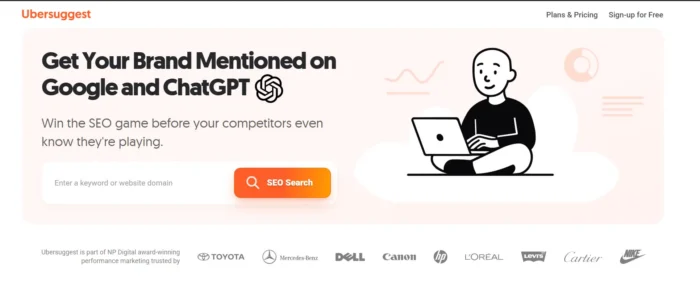
There’s no feature list or product description. Just the outcome the audience cares about.
That focus is intentional. Your copy can’t solve every problem, and it shouldn’t try to.
Identify the most common pain points your audience faces and build your message around the one you solve best. Customer interviews and support ticket trends are all reliable ways to surface what really matters to your audience.
6. Leverage Social Proof
Consumers do their homework before they buy.
According to recent data from BrightLocal, 41 percent of consumers “always” read reviews when browsing for businesses, a significant jump from 29 percent the year before (2025).
If your copy doesn’t include social proof, then you could be leaving customers on the table.
The reason it works is that people trust other people more than they trust brands. A stranger’s review carries more weight than your best marketing copy, because it comes without a motive to sell.
There are two smart ways to use social proof in your copywriting.
First, let it inform your messaging. Reviews and customer surveys reveal exactly what language your audience uses to describe the problems and benefits they care about most.
Second, place it strategically on landing pages and homepages where buying decisions are made.
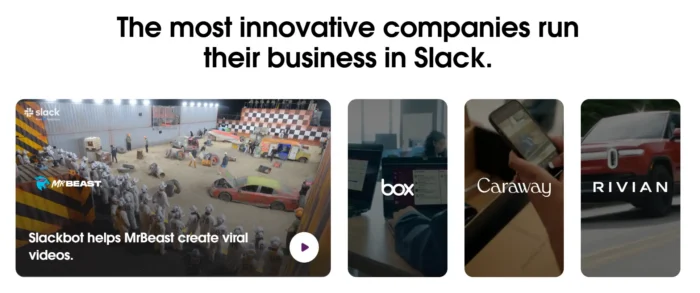
Social proof can apply to B2B brands, too. For example, Slack lets other businesses know they’ll be joining “the most innovative companies” by using their service:
Source: https://slack.com/
That single phrase tells a prospective customer that the decision has already been made by people like them.
Case studies, testimonials, star ratings, and media mentions all establish trust before your copy even has to ask for the sale.
7. Avoid Fluff and AI Tells
In the age of AI-generated content, copy that reads like it came off an assembly line can erode trust in your brand.
AI tools can be incredibly useful, but you still need to edit like a human. That means cutting the filler phrases that weaken your message and replacing predictability with personality.
Here are some of the most common AI tells to eliminate from your copy. The fix is often as simple as deleting or reordering a few words.
- “When it comes to…”
- The tell: When it comes to marketing, copywriting is a must-have skill.
- The fix: Copywriting is a must-have marketing skill.
- “It’s important to know/remember…”
- The tell: It’s important to remember to track your marketing campaign metrics.
- The fix: Remember to track your marketing campaign.
- “By doing X, you can do Y”
- The tell: By tracking campaign metrics, you can optimize the success of your marketing.
- The fix: Tracking campaign metrics helps you optimize the success of your marketing.
- “Ever-evolving landscape of…”
- The tell: AI tools are essential to survival in the ever-evolving landscape of copywriting.
- The fix: AI tools are essential to your survival as a copywriter.
- “Whether you do X or Y…”
- The tell: Whether you post blogs or record videos, your storytelling skills are important.
- The fix: Strong storytelling resonates regardless of the format you choose.
- “ABC isn’t X—it’s Y”
- The tell: Marketing isn’t about listing features, it’s about telling stories.
- The fix: Marketing is about telling stories that move people to act.
- “ABC does more than X — they Y”
- The tell: Marketers do more than advertise products, they provide solutions.
- The fix: Marketers connect people with solutions to real problems.
- Predictable lists of three (“X, Y, and Z”)
- The tell: Strong copy requires clarity, brevity, and a compelling call to action.
- The fix: Strong copy is clear and concise, with every word earning its place, including the CTA.
If a phrase delays you getting to your point or creates a robotic cadence, cut it.
A good rule of thumb is to read your copy out loud. If it sounds like something a machine would write, it needs another pass.
8. Test Your Copywriting
What resonates with your audience today might fall flat in six months. The only way to know what’s actually working is to test it.
A/B testing web copy means running two versions of the same element against each other to see which drives more action. According to a recent benchmark report from Unbounce, the median landing page conversion rate across 41,000 pages is just 6.6 percent.
That number leaves a lot of room for improvement, and systematic testing is how you close the gap.
The key is to test one variable at a time. If you change too many things at once, you won’t know what actually moved the needle.
Focus your tests on:
- Headlines: Test different angles, benefit statements, or emotional hooks.
- CTAs: Try variations in wording and placement to find what drives the most clicks.
- Point of view: Compare second-person options like “you can save” against direct imperatives like “save now.”
- Button copy: Make small wording shifts and measure the impact on conversions.
Testing is how you stay current with what the market wants. Audience expectations shift over time, and copy that converts well in January may need to be adjusted by Q4 as seasonal priorities change.
Building testing into your process as a habit is the best way to stay ahead of the curve.
9. Use Engaging Data and SME Proof
With AI becoming widely adopted, it’s easy for just about anyone to produce content at scale. However, the question becomes: Is it effective, high-quality content?
Today, facts and data backed by subject matter expert (SME) proof are essential for your copy’s credibility and visibility.
According to the Content Marketing Institute’s B2B Content Marketing Report, only 4 percent of B2B marketers report a high level of trust in generative AI content output.
Audiences are skeptical of AI-generated copy for good reason, but one of its biggest crimes is that it often makes assertions without evidence. The way for copywriters to stand out is to be someone who actually backs their claims.
This is what Google’s framework, experience, expertise, authoritativeness, and trustworthiness (E-E-A-T), looks like in practice. And it’s a ranking signal for traditional search and AI systems.
Content that demonstrates genuine expertise through proprietary data and named expert quotes is significantly more likely to earn citations in both traditional and AI-powered search.
For copywriters, the practical takeaway is to replace vague assertions with specific figures whenever possible. Swap anonymous claims for named expert quotes. Commission original research so your brand owns the data, as my team did with our AI hallucinations study:
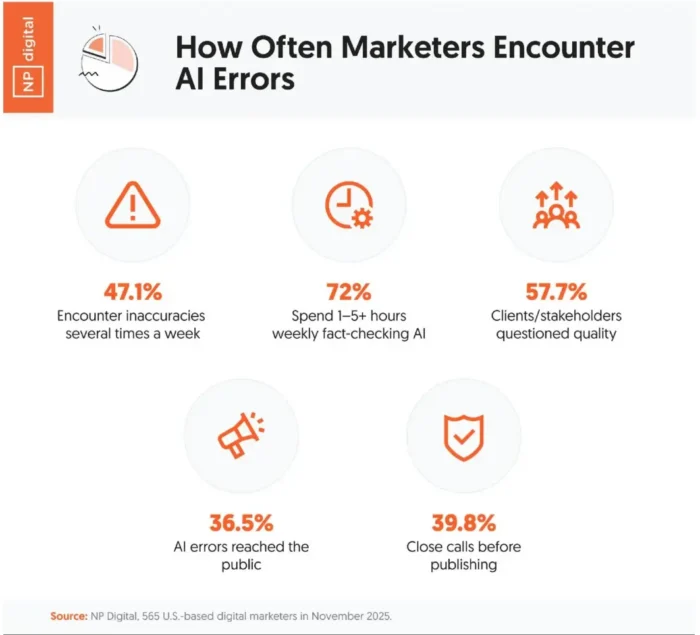
If you can’t do that, the next best option is to source data from original, credible sources. Track data all the way back to the original organization or company that researched it.
Another best practice is to use only data points from highly credible sites. Publications such as peer-reviewed academic journals and case studies are great places to look.
Implementing these copy improvements will result in strong copy that signals to both readers and AI systems that your content is worth citing.
10. Build Your Call to Action
Potential customers who visit your website need a clear path to follow. A CTA gives them that, telling them exactly what to do next. The goal is to remove any hesitation about taking that step.
Specific language like “Get your free report” outperforms generic phrasing like “Submit.” Specificity reduces friction and makes the value clear to the customer before they click.
CTAs are even more important on landing and product pages built around a single conversion goal.
A few principles worth keeping in mind for CTA success:
- Use action-oriented verbs.
- Keep CTA language short.
- Align the CTA messaging with the copy above it.
You can take things a step further by A/B testing your CTAs. It should be a regular part of your process, since even the smallest wording changes can drive meaningful lifts in conversion.
Copywriting for AI Visibility: What to Do
AI visibility is whether your brand gets cited or recommended by large language models (LLMs). It’s becoming as important to track as your search rankings. If your brand isn’t showing up as the answer to your audience’s queries on AI platforms, you risk being left out of the conversation entirely.
McKinsey’s AI Discovery Survey says half of consumers now intentionally seek out AI-powered search engines, and a majority say AI is the top digital source they use to make buying decisions. The good news is that many of the principles that make copy effective for humans also make it more likely to be cited by AI.
A few strategies that can help:
- Lead with clear, direct answers. AI systems favor content that gets to the point.
- Use specific data and named sources. Vague claims get skipped, while cited stats get repeated.
- Structure content with descriptive headers. Well-organized copy is easier for AI systems to parse and extract answers from.
- Include expert quotes with credentials. Named authority signals are weighted heavily as they establish credibility.
- Keep your copy current. AI systems favor recently published, frequently updated content.
How to Use AI for Copywriting (the Right Way)
AI writing tools are most useful when you treat them as a first-draft engine. Editing is important, but the output is only as good as the direction and input you give it up front.
The way you design your prompts is critical in making the most out of AI-generated content. Vague requests produce vague copy. The more context you give the tool, the more useful the output will be.
Compare these two prompts:
- Weak: “Write a headline for my email marketing tool.”
- Strong: “Write five headline options for a landing page promoting an email marketing tool for e-commerce brands. The tone should be direct and confident. The main benefit is saving time through automation. The CTA is ‘Start your free trial.’”
The second prompt gives the AI something to work with. The first gives it practically nothing.
A strong copywriting prompt includes:
- Your target audience
- The goal of the piece
- The tone you want
- Any key points to hit
Once you have a draft, that’s where your work begins. Read it aloud and ask whether the cadence sounds or feels robotic. Does it sound like your brand? Does it lead with the right pain point and have a strong CTA?
AI can draft, but only you can judge whether it converts. Think of it as a collaboration where AI gives you the basic building blocks, and you turn it into something worthwhile.
FAQs
What is copywriting?
Copywriting is the practice of writing persuasive text designed to get the reader to take a specific action, like a sign-up or a purchase. It appears across ads, emails, landing pages, and websites. Unlike content writing, which builds awareness over time, copywriting is conversion-focused. Every word serves a purpose, and even small copy changes can produce significant lifts in revenue.
What does a copywriter do?
A copywriter specializes in creating ad copy and other marketing materials. They are also responsible for writing persuasive sales copy, such as catchy slogans and attention-grabbing headlines.
How do you become a copywriter?
You don’t need any specific qualifications to become a copywriter. What you need are strong writing skills and an ability to understand how to inspire your target audience into taking action.
{
“@context”: “https://schema.org”,
“@type”: “FAQPage”,
“mainEntity”: [
{
“@type”: “Question”,
“name”: “What is copywriting?”,
“acceptedAnswer”: {
“@type”: “Answer”,
“text”: “
Copywriting is the practice of writing persuasive text designed to get the reader to take a specific action, like a sign-up or a purchase. It appears across ads, emails, landing pages, and websites. Unlike content writing, which builds awareness over time, copywriting is conversion-focused. Every word serves a purpose, and even small copy changes can produce significant lifts in revenue.
”
}
}
, {
“@type”: “Question”,
“name”: “What does a copywriter do?”,
“acceptedAnswer”: {
“@type”: “Answer”,
“text”: “
A copywriter specializes in creating ad copy and other marketing materials. They are also responsible for writing persuasive sales copy, such as catchy slogans and attention-grabbing headlines.
”
}
}
, {
“@type”: “Question”,
“name”: “How do you become a copywriter?”,
“acceptedAnswer”: {
“@type”: “Answer”,
“text”: “
You don’t need any specific qualifications to become a copywriter. What you need are strong writing skills and an ability to understand how to inspire your target audience into taking action.
”
}
}
]
}
Conclusion
AI can generate copy at scale, but scale without strategy produces noise. The brands that stand out are the ones investing in copy that’s human and built around a real understanding of their audience. That’s a skill no tool can fully replicate.
The strategies in this guide give you a framework to start with. As you put them into practice, dig into the psychology behind why copy converts. Understanding what motivates your reader at a deeper level is what separates good copy from great copy.
When you feel confident with the copywriting basics, you can focus on more targeted copywriting strategies that move the conversion needle.