
Structuring a Website with /fr/ And /en/

Reaching both English and French audiences online takes more than translating a few pages and adding a language toggle. Effective multilingual SEO starts with a clear site architecture that helps search engines understand which content belongs to which audience. For brands investing in French English SEO, the right setup is essential for visibility, usability, and long-term growth.
In this guide, we’ll break down how to build the ideal multilingual website structure using /fr/ and /en/ directories, why this approach supports stronger multilingual website SEO, and what it takes to make SEO for bilingual websites actually work.
What Is Multilingual SEO?
Multilingual SEO is the practice of structuring, optimizing, and publishing website content in multiple languages so search engines can correctly index and serve the right language version to the right audience.
In practical terms, it means building a website architecture where English and French pages are treated as distinct pieces of content while still sharing domain authority. This distinction matters more than most teams realize.
Search engines don’t simply “translate” ranking signals between languages. When a page exists in both English and French, Google interprets them as separate documents. Each one must establish relevance, authority, and intent alignment independently.
That nuance is where many multilingual websites struggle. Pages get translated, uploaded, and technically exist, but they never gain meaningful visibility because the search signals were never properly built.
Practical Examples of Multilingual Businesses
Many Canadian companies operate across both English and French markets. Businesses selling physical infrastructure products, like floating docks or companies manufacturing prefab homes, often serve bilingual audiences across Quebec, Ontario, and other regions. A well-structured multilingual site ensures each language market can discover the right content without competing with the other language versions.
How Google Treats Different Languages in Search
Why Google Indexes French and English Pages Separately
Google indexes language versions as separate documents.
That means a page at:
example.com/fr/service
and
example.com/en/service
are treated as independent assets within the search index.
Ranking signals like backlinks and topical authority still contribute to the domain overall, but page-level ranking relevance must be earned separately in each language. This is why launching an English section on a previously French website often feels like starting SEO from scratch. Technically, it isn’t. But from a search visibility standpoint, it behaves very similarly.
Quick Reference: Language Indexing
|
Element |
English Page |
French Page |
|
URL Example |
example.com/en/service |
example.com/fr/service |
|
Indexed As |
Separate document |
Separate document |
|
Ranking Signals |
Earned independently |
Earned independently |

Source: Image Generated by Gemini
Why Each Language Behaves Like Its Own SEO Market
French and English search ecosystems behave differently.
Search demand varies.
Competitors vary.
SERP layouts vary.
Even user expectations shift depending on language context.
A query that drives significant traffic in English might barely exist in French. Meanwhile, a French search phrase might dominate a niche category with very little competition.
Treating both languages with the same keyword assumptions almost always leads to missed opportunities.
Best URL Structure for Multilingual Websites
Multilingual Site Structure Options
There are three common approaches for multilingual site architecture:
- Country-code domains (example.ca vs example.fr)
- Subdomains (fr.example.com)
- Subdirectories (example.com/fr/)
Each model technically works. But most SEO teams eventually gravitate toward one option.
Comparison of Multilingual URL Structures
|
Structure Type |
Example |
SEO Complexity |
Authority Sharing |
|
Country Domains |
example.ca / example.fr |
High |
Split authority |
|
Subdomains |
fr.example.com |
Medium |
Partial sharing |
|
Subdirectories |
example.com/fr/ |
Low |
Full authority sharing |
Why Subdirectories Usually Win
Subdirectories allow all language versions to share the same domain authority.
Instead of splitting link equity across multiple domains or subdomains, the entire website contributes to one consolidated authority signal.
For most businesses, this dramatically simplifies SEO growth.
Developers also tend to prefer this structure because it avoids complicated hosting configurations.
Examples of a Clean Multilingual URL Structure
Here are a few examples of what a clean multilingual URL structure can look like in practice:
- example.com/fr/
- example.com/en/
- example.com/fr/service
- example.com/en/service
This structure keeps language segmentation extremely clear. And clarity matters — not just for users, but for crawlers.
Why Mixing Languages on the Same URL Causes Problems
When English and French content appear on the same URL, search engines struggle to determine which language the page should rank for.
The result is usually one of three outcomes:
- indexing confusion
- diluted keyword relevance
- inconsistent ranking behaviour
It sounds obvious, but it happens surprisingly often, especially when translation plugins dynamically swap content without changing URLs.
Implementing hreflang Correctly
What hreflang Actually Does
The hreflang attribute signals alternate language versions of the same content. It helps search engines understand that multiple pages exist for different language audiences rather than interpreting them as duplicate content.
Without hreflang, multilingual websites frequently experience ranking conflicts between language versions.
Correct hreflang Codes for Canadian Websites
For Canadian multilingual sites, the typical tags are:
An optional x-default tag can point to a language selection page.
Example hreflang Structure
Each page should reference:
- itself
- its alternate language version
- any additional regional variants
Reciprocal linking between language versions is required. Missing reciprocal tags is one of the most common technical errors in multilingual SEO.
Why Direct Translation Fails for SEO
Translation vs Localization
Translation converts text. Localization adapts content to the search behaviour of a specific audience. The difference is subtle but incredibly important.
Literal translation rarely reflects how users actually search in another language. The phrase structure changes. Terminology changes. Sometimes the entire search concept changes.
This is where most teams get it wrong. They assume translated content automatically becomes searchable content. In reality, it often becomes invisible content.
Turning Translated Content into SEO Content
Localization usually requires rewriting key structural elements:
- page titles
- headings
- calls-to-action
- keyword phrasing
The goal is not linguistic accuracy alone—it’s search intent alignment.
Keyword Research for French and English SEO
Why Keywords Cannot Simply Be Translated
Search demand rarely maps one-to-one across languages.
An English query with 10,000 searches per month might only generate a few hundred searches in French.
Other times, the reverse is true.
This is why multilingual keyword research must happen independently for each language.
Example of Keyword Variation Between Languages
|
English Query |
Approx French Equivalent |
Search Behaviour |
|
SEO agency |
agence SEO |
Higher competition |
|
multilingual SEO |
SEO multilingue |
Moderate demand |
|
technical SEO audit |
audit SEO technique |
Lower competition |
Multilingual Keyword Research Process
A typical process includes:
- identifying primary queries in one language
- analyzing the existing SERPs
- mapping keywords to pages
- identifying gaps in competing content
Tools like Google Keyword Planner, Ahrefs, and SEMrush are commonly used for this analysis.
Structuring Bilingual Website Content
Unique Titles and Metadata for Each Language
Metadata should never be duplicated across languages.
Each page requires a title, description, and H1 written for native speakers.
This improves both click-through rates and ranking relevance.
Language-Specific Internal Linking
Internal linking should stay within the same language ecosystem.
French pages link primarily to other French pages.
English pages link primarily to English pages.
Cross-language linking should only exist when intentionally guiding users to alternate versions.
Technical SEO Checklist for Multilingual Websites
Several technical details quietly determine whether multilingual SEO succeeds or stalls.
These include:
- separate XML sitemaps for each language
- proper canonical tags
- crawlable language directories
- consistent structured data
For example:
/sitemap-fr.xml
/sitemap-en.xml
Search engines use these signals to understand the architecture of multilingual content.
Quick Technical Checklist
|
Technical Element |
Why It Matters |
|
hreflang tags |
Prevent language indexing conflicts |
|
separate sitemaps |
Clarifies language architecture |
|
canonical tags |
Avoids duplication issues |
|
structured data |
Improves AI extraction |
Tracking Multilingual SEO Performance
Performance monitoring should also be separated by language.
The simplest approach is creating separate Search Console properties for:
example.com/fr/
example.com/en/
This allows SEO teams to measure:
- rankings by language market
- impressions by language
- click-through rates
- content performance differences
Sometimes a French page outperforms its English equivalent by a dramatic margin, even when the topic is identical. Understanding why can unlock useful strategy insights.
Competitive Differences Between French and English SERPs
French search markets often have lower competition. The content ecosystem is smaller, which means high-quality localized content can rank surprisingly quickly.
English search results, on the other hand, tend to be far more saturated. This means content depth, backlinks, and topical authority requirements are usually higher.
Optimizing Multilingual Content for AI Search
Search behaviour is evolving beyond traditional search engines.
AI systems increasingly extract answers directly from structured content.
For multilingual websites, this means structuring pages so both language versions contain:
- clear definitions
- concise explanations
- well-organized headings
Answer-ready content dramatically increases the chances of appearing in AI summaries and citations.
Real-World Application of Multilingual SEO
Companies that operate across regional Canadian markets often rely on multilingual SEO to reach both English and French audiences effectively. Industries like waterfront construction products or modular housing frequently benefit from properly localized content, especially when customers search for terms, such as floating docks or prefab homes, in different languages.
When the content architecture is correct, each language section becomes its own growth channel while still strengthening the domain as a whole.
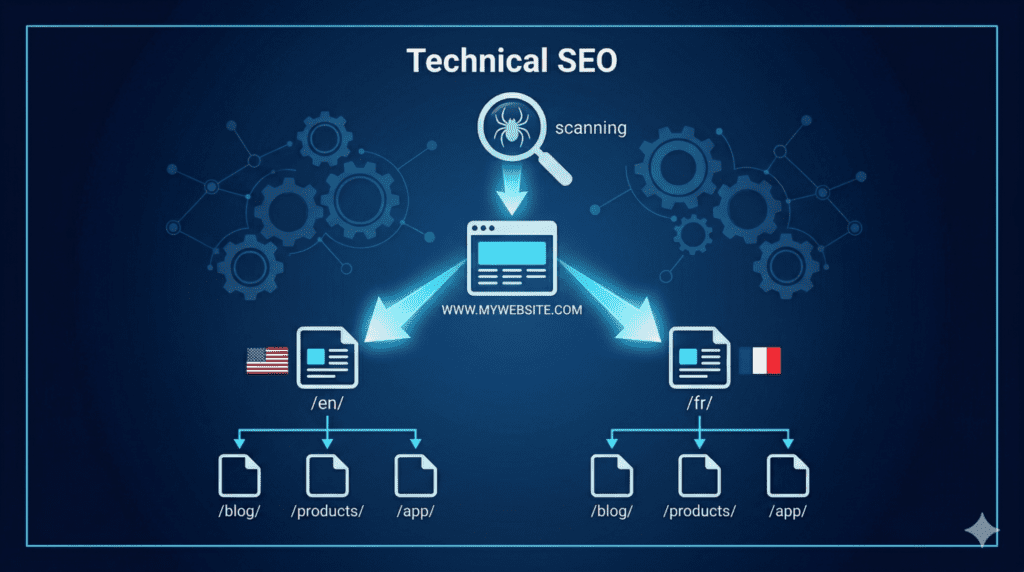
Source: Image Generated by Gemini
Common Multilingual SEO Mistakes
Several mistakes consistently undermine multilingual SEO performance:
- automated translation without review
- missing hreflang tags
- duplicated metadata
- mixed-language pages
- translated keyword strategies
Most of these problems originate from assuming multilingual SEO is simply a translation task. In reality, it is a full technical and strategic discipline.
Multilingual Website Launch Checklist
Before launching a bilingual website, SEO teams should confirm:
- language directories are configured
- hreflang tags are implemented
- keyword research is completed for both languages
- metadata is localized
- internal linking respects language structure
- sitemaps are submitted
- performance tracking is configured
When these fundamentals are implemented correctly, multilingual SEO becomes far more predictable.
And predictable SEO is rare enough to be valuable.
Multilingual SEO: Building a Bilingual Website That Performs
Strong multilingual SEO is not just about publishing content in two languages. It requires a thoughtful multilingual website structure, clean technical implementation, and a strategy tailored to how users search in each market. When done right, bilingual SEO allows your /fr/ and /en/ sections to rank independently while strengthening your domain as a whole. From hreflang SEO to content localization and keyword mapping, successful SEO for bilingual websites depends on getting both the technical and strategic pieces right.
If your business is planning a bilingual expansion or wants to improve its multilingual website SEO, TechWyse can help. Our team supports brands with technical SEO audits, hreflang SEO implementation, multilingual keyword research, content localization, website architecture planning, and ongoing French English SEO strategy to help your site perform across both language markets. To get started, call 866-208-3095 or contact us here.