
SEO Retainers: How to Turn One-Off Projects Into Recurring Revenue

An SEO retainer is a recurring monthly agreement where an agency delivers ongoing SEO work for a set fee, instead of billing one project at a time. For agencies, retainers turn unpredictable project income into stable, compounding recurring revenue, and they fit SEO perfectly because SEO is never truly finished.
You land an SEO project. You scope it, deliver it, and the rankings start to move. Then, somewhere around month four, the client asks the question every agency hears: what’s next? The initial work is done, the easy wins are banked, and you are staring at the same wall you hit with the last client. Either you sell them something new, or the relationship quietly winds down and you go hunting for the next project.
That wall is the whole problem with the one-off model. Your revenue resets to zero every time a project ends, and you spend as much energy finding the next deal as delivering the current one. Retainers solve it. This guide covers what an SEO retainer is, why it beats project work for your agency, and the exact playbook for turning a transactional client into recurring monthly revenue.
What is an SEO retainer?
An SEO retainer is an ongoing monthly agreement where you deliver a set scope of SEO work for a recurring fee. Instead of paying for a one-time project, the client pays every month for continued content, links, technical work, and reporting.
The difference from project work is continuity. A project has a fixed scope and an end date: audit the site, fix the issues, build a batch of links, and you are done. A retainer has no end date by design. Each month you continue the work that keeps rankings climbing, which is exactly how SEO produces results in the first place.
That is why retainers are the default model for serious SEO. Search is not a one-time fix. Google updates its algorithm, competitors publish new content, your client’s existing pages decay, and now AI search adds a whole new surface to compete on. Ongoing work is not an upsell you invented. It is the honest shape of what SEO requires.
Why do retainers beat one-off SEO projects?
Retainers give your agency predictable monthly revenue, a higher lifetime value per client, and a stable relationship, while matching how SEO works in practice: continuously, not in a single burst.
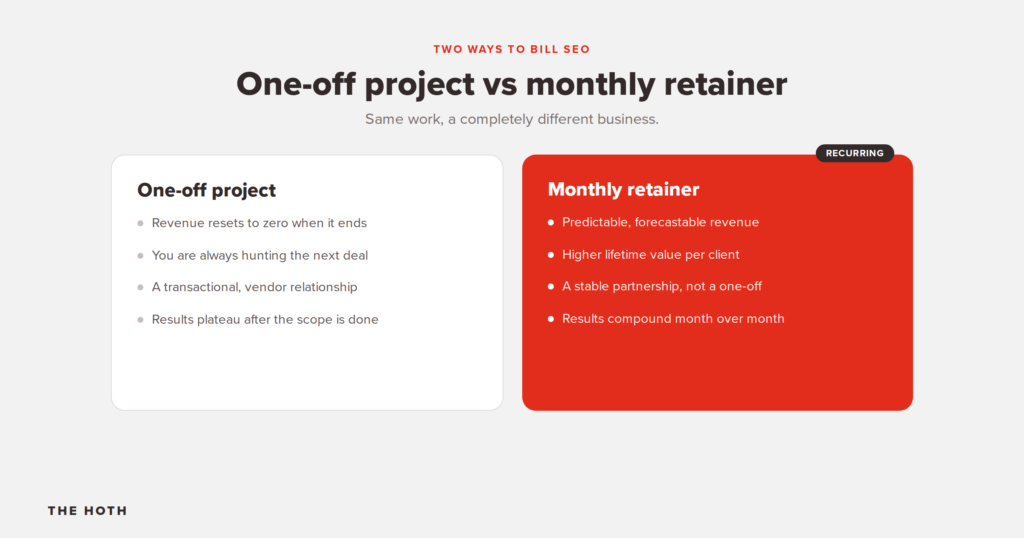
Compare the two models side by side. With ala carte or project work, you sell a fixed deliverable, collect once, and start the clock on finding the next sale. Margins are fine, but revenue is lumpy and the relationship is transactional. The client thinks of you as a vendor they hire when they need something.
With a monthly retainer, the same client becomes recurring revenue you can forecast. Your average client is worth far more over its lifetime, your income smooths out, and because you are delivering results every month, the client has every reason to stay. You stop being a vendor and become the partner who runs their search presence. For most agencies, that shift from project income to recurring revenue is the single biggest lever on the value of the business.
Put rough numbers on it. Ten one-off projects at 2,000 dollars each is 20,000 dollars, once. Ten retainer clients at 2,000 dollars a month is 20,000 dollars every month, and it grows as you add clients without losing the ones you already have. Same client count, a completely different business.
The retainer is better for the client too, which makes it an easier sell. One-off projects leave the client to maintain momentum on their own, and most never do. A retainer means someone is always moving their rankings forward, adapting to algorithm changes, and defending the positions already won. You are not only selling recurring revenue for yourself, you are selling a better outcome for them.
Why do one-off SEO projects hit a wall?
One-off projects reset your revenue to zero at the end of every engagement, so you spend as much energy selling the next deal as delivering the current one. The model caps your growth at whatever you can close this month.
The wall tends to show up around month three or four, when the initial scope is complete. The client has what they paid for, the results are real, and then nothing is scheduled. If you have not planted the idea of ongoing work, the relationship stalls exactly when it is most valuable. You lose the account, the momentum plateaus, and you start the sales cycle over with someone new. Multiply that across every client and you have an agency that works hard just to stay in the same place.
How do you turn a one-off client into a retainer?
Set the expectation that SEO is ongoing, deliver a visible early win, show the client the roadmap of what is still on the table, and package the next phase as a monthly plan rather than another one-off quote.
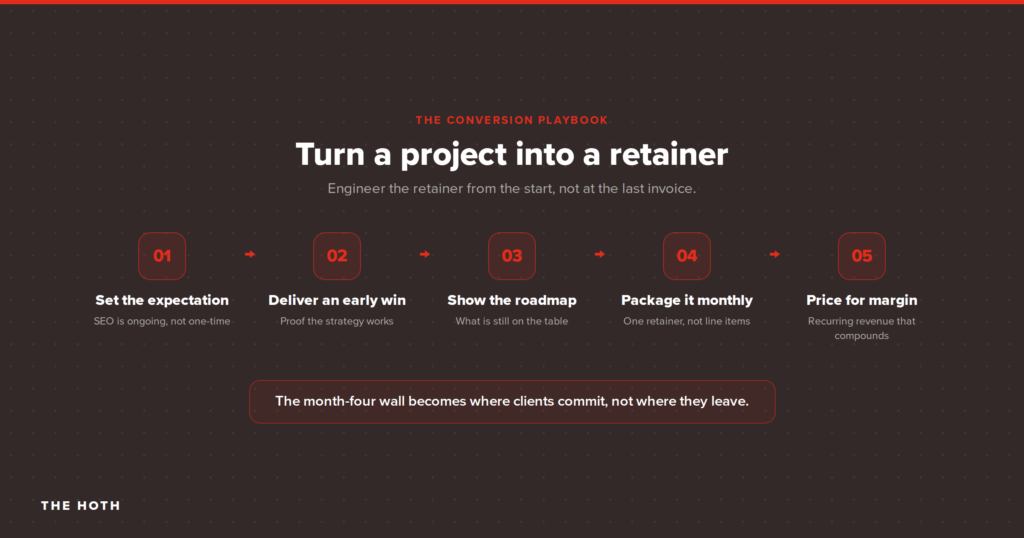
The conversion does not happen by accident at month four. You engineer it from the start. Here is the playbook.
1. Set the expectation early
From the first conversation, frame SEO as an ongoing program, not a one-time fix. Tell the client that the project gets the foundation in place and that the compounding results come from sustained work. When you set that expectation up front, the retainer conversation later feels like the natural next step instead of a surprise upsell.
2. Deliver a visible early win
Nothing sells a retainer like results the client can see. Target a few achievable keywords or a clear technical improvement early, so that by the time you propose ongoing work, you have proof the strategy works. Momentum is your best closer.
3. Show the roadmap
At the point where a project would normally end, show the client everything still on the table: the content that has not been built yet, the links that would push competitive terms over the line, the AI visibility work their competitors are already doing. Make the gap between where they are and where they could be impossible to ignore.
4. Package it as a monthly plan
Do not quote the next phase as another one-off deliverable. Bundle the ongoing work into a single monthly retainer with a clear scope and a clear price. Package pricing closes better than itemized deliverables because it is easy to say yes to and easy to renew. If you want a breakdown of which services to bundle, our guide to the easiest HOTH products to resell maps products to the conversations you are already having.
5. Price for recurring margin
Set your retail price to cover the strategy, account management, and reporting you provide on top of fulfillment, and to leave a healthy recurring margin. Because the revenue repeats every month, even a modest markup compounds into meaningful income across a book of retainer clients.
What should an SEO retainer include?
A strong SEO retainer bundles the work that compounds: ongoing content, link building, technical maintenance, and reporting, and in 2026 it should include AI visibility too.
The specific mix depends on the client, but the core of a retainer is the ongoing work that keeps results climbing:
- Content. New pages and refreshed existing ones that expand the keywords you rank for.
- Link building. A steady flow of authoritative links that pushes competitive terms up the page.
- Technical maintenance. Ongoing fixes so site health does not quietly erode the rest of the work.
- Reporting. Monthly reporting that shows the client exactly what the retainer is producing, which is what keeps them renewing.
- AI visibility. Earned media and reputation work that gets the client cited in ChatGPT and AI Overviews, the fastest-growing part of any retainer conversation.
How much should you charge for an SEO retainer?
SEO retainers commonly run from a few hundred dollars a month for small local clients to several thousand for competitive campaigns. Your price should reflect scope, competition, and market, set as a markup over your fulfillment cost.
There is no single right number, because a local plumber and a national ecommerce brand need very different scopes. What stays constant is the structure. You carry a wholesale or fulfillment cost, then set a retail price that covers your strategy, management, and reporting and leaves a recurring margin. Many agencies mark up two to four times. The important move is to anchor the conversation on outcomes and the ongoing nature of the work rather than an hourly rate, so the client is buying a result, not counting deliverables.
What does an SEO retainer look like month to month?
A typical retainer runs on a steady monthly cadence: a batch of content, a set of new links, ongoing technical fixes, and a report that ties it all back to results. The scope stays consistent so the client always knows what they are getting.
For example, a mid-size retainer might deliver two to four new or refreshed pages, a handful of authoritative links, a technical health check, and a clear monthly report. A larger campaign scales every lever up. The consistency matters as much as the volume, because a predictable rhythm of work is what compounds into rankings and what makes the value obvious on the report. When the client can see the same reliable output producing steady gains, renewing is the easy choice.
How managed SEO lets you sell retainers without a team
A managed SEO partner runs the full retainer campaign under your brand, so you can sell recurring SEO without hiring content writers, link builders, and technical specialists. You own the client and the margin; the partner runs the work.
This is the part that stops most agencies from selling retainers: fulfilling ongoing SEO takes a whole team. Our Managed SEO program solves that. Each account gets a dedicated campaign manager who runs a full-suite campaign, links, content, technical work, and reporting, and every deliverable comes back through a white label dashboard with no HOTH branding. Wholesale starts around 1,000 dollars a month and scales by scope, and you set the retail price your client pays.
Compare that to building the capability in house. Hiring even one experienced SEO specialist runs into six figures a year, and one person cannot cover content, links, and technical well. Assembling a full team takes months and a lot of fixed overhead you carry whether or not you have retainer clients to support it. A managed partner gives you the same capability on day one, at a cost that scales with your revenue. You can read how agencies structure this in our guides to the SEO reseller program and reselling SEO.
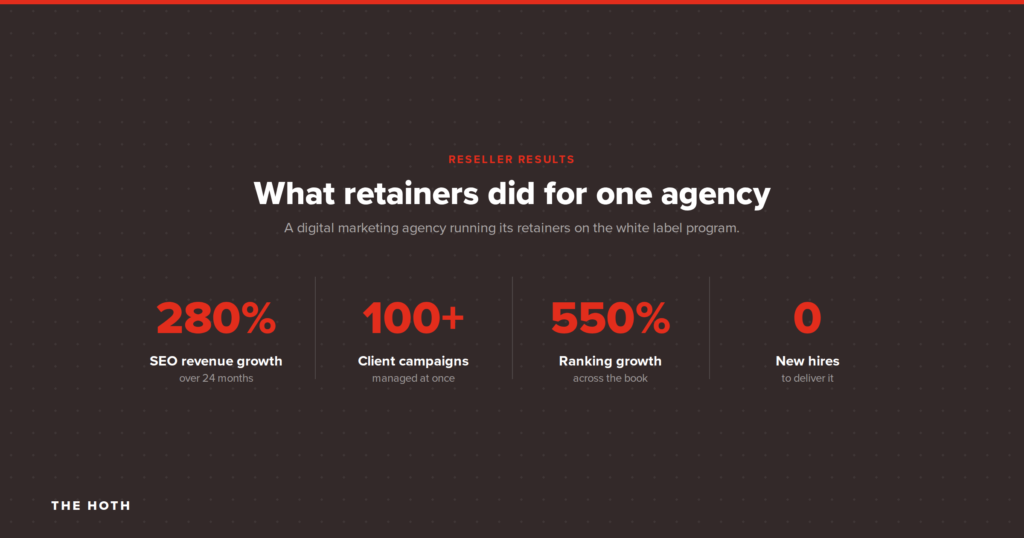
The results back up the model. A fast-growing digital marketing agency that ran its retainers through our white label program grew its SEO revenue by 280% over 24 months while managing more than 100 client campaigns, with zero new hires. Keyword rankings improved 550% across their book of business. They owned every client relationship. We ran the fulfillment in the background. That is what recurring revenue looks like when the delivery is handled for you.
Common mistakes when selling SEO retainers
The usual mistakes are waiting until a project ends to raise the retainer, pricing per deliverable instead of per outcome, and promising ongoing work you do not have the team to deliver.
A few traps catch agencies. Waiting until the last invoice to mention ongoing work, so the retainer feels like a scramble instead of a plan. Selling the retainer as a list of line items, which invites the client to trim it, rather than as an outcome they are buying. Underpricing to win the deal, then resenting the margin every month. And the big one, closing a retainer you cannot fulfill because you have no team and no partner to run the monthly work. Avoid these, and the retainer becomes the most natural sale your agency makes.
How to start selling SEO retainers
If you have clients finishing up one-off projects right now, you already have your first retainer prospects. Set the expectation, show them the roadmap, and package the next phase as a monthly plan your Managed SEO partner fulfills under your brand. When you want to map out your first retainer offer and pricing, book a call with our team, and we will help you build a package that fits your client base.
Frequently asked questions
How much does an SEO retainer cost?
It varies widely by scope and market. On the fulfillment side, managed SEO wholesale starts around 1,000 dollars a month and scales with the work involved. As the agency, you set the retail price, and most resellers mark services up two to four times to cover their strategy, management, and margin.
How long should an SEO retainer last?
SEO compounds over time, so retainers are usually measured in quarters and years, not weeks. Most clients need six to twelve months to see the full effect, and the strongest results come from relationships that continue well beyond that. The ongoing nature is the point, not a drawback.
SEO retainer vs project: which is better?
For your agency, a retainer is almost always better, because it produces recurring revenue and a stable relationship. Projects still make sense for one-time needs like a migration or a single audit, but the compounding work that drives rankings belongs in a retainer.
How do I sell an SEO retainer without an in-house team?
Use a managed SEO partner that fulfills the work under your brand. You sell the retainer, own the client relationship, and forward unbranded reports, while the partner runs the content, links, technical work, and reporting behind the scenes.
What should be included in an SEO retainer?
The compounding work: ongoing content, link building, technical maintenance, monthly reporting, and increasingly AI visibility work so the client shows up in AI answers as well as Google.
The bottom line
The one-off project model caps your agency at whatever you can sell this month. Retainers break that ceiling by turning each client into recurring revenue and each result into a reason to stay. Set the expectation early, prove the work with an early win, show the roadmap, and package the next phase as a monthly plan a managed partner fulfills under your brand. Do that, and the month-four wall stops being where clients leave and becomes where they commit.