
How to Show AI Trust Signals on Every Page

E-E-A-T SEO is the practice of making your experience, expertise, authoritativeness, and trustworthiness visible on every page, through bylines, first-hand detail, cited sources, reviews, and off-site mentions. Google says its AI features run on the same ranking and quality systems as regular Search, so the signals that earn trust in rankings now help decide which pages AI answers cite.
You published a solid page. It’s accurate, it’s thorough, and it ranks on page one. Then you check the AI Overview for your main keyword and find a competitor quoted instead of you.
That gap usually isn’t about keywords. It’s about proof. AI systems pull from sources they can trust, and trust gets judged through signals most sites leave half-finished: a vague byline, a statistic with no source, an “updated” date that doesn’t match any real update, or a brand nobody else on the web talks about.
The good news is that every one of those signals can be fixed at the page level. We’ve already covered why AI engines screen brands for safety before recommending them. This guide is the practical follow-up: what E-E-A-T means now, why AI leans on it, and a page-by-page checklist you can run against your own site this week.
What Is E-E-A-T SEO, and What Changed?
E-E-A-T stands for experience, expertise, authoritativeness, and trustworthiness, the framework Google uses to describe the content it wants to surface. It isn’t a single ranking factor, but Google’s systems use a mix of signals to identify content that shows it, and those same systems now feed Google’s AI answers.
The framework comes from Google’s quality rater guidelines, and the first E, experience, was added in late 2022. Google’s documentation on creating helpful, reliable, people-first content says trust is the most important of the four. The other three feed into it, and a page doesn’t need to show all of them to be helpful. Google also gives extra weight to strong E-E-A-T on “Your Money or Your Life” topics like health, finance, and safety.
Here’s the part that trips people up. E-E-A-T isn’t a score sitting inside Google’s algorithm. Google works with roughly 16,000 external quality raters who check whether its results are reliable, and Google’s Search Quality Rater Guidelines overview explains that raters look at who is responsible for a site, who created the content, and what real users and subject experts say about its reputation. Their ratings help Google judge whether its systems are working. They don’t move individual pages up or down.
So think of E-E-A-T as a description of what Google’s automated signals are trying to detect. Your job isn’t to “add E-E-A-T” to a page. It’s to make the evidence easy to find.
What changed with AI search?
What changed is where those signals pay off. Google’s guide to optimizing for generative AI features says AI Overviews and AI Mode are rooted in its core ranking and quality systems. The AI retrieves pages from the Search index, reviews what they say, and builds an answer with links to the pages that support it.
That means the trust checks that shaped your rankings now shape whether you get cited at all. And because an AI answer only cites a handful of sources, ranking somewhere on page one isn’t enough. Our citation gap research found that roughly half the sites Google’s AI Overviews cite for buyer queries don’t rank on page one for those queries.
Where does topical authority fit?
Topical authority is E-E-A-T at the site level. One excellent page shows expertise on one question. A connected cluster of pages shows you know the whole subject. Google hasn’t published a topical authority metric, so treat it as a pattern your content creates rather than a number you can move.
If you’re building clusters, our guide to content clusters for topical authority walks through the structure. Everything in the checklist below applies to every page inside that cluster.
Why Do AI Answer Engines Rely on E-E-A-T Signals?
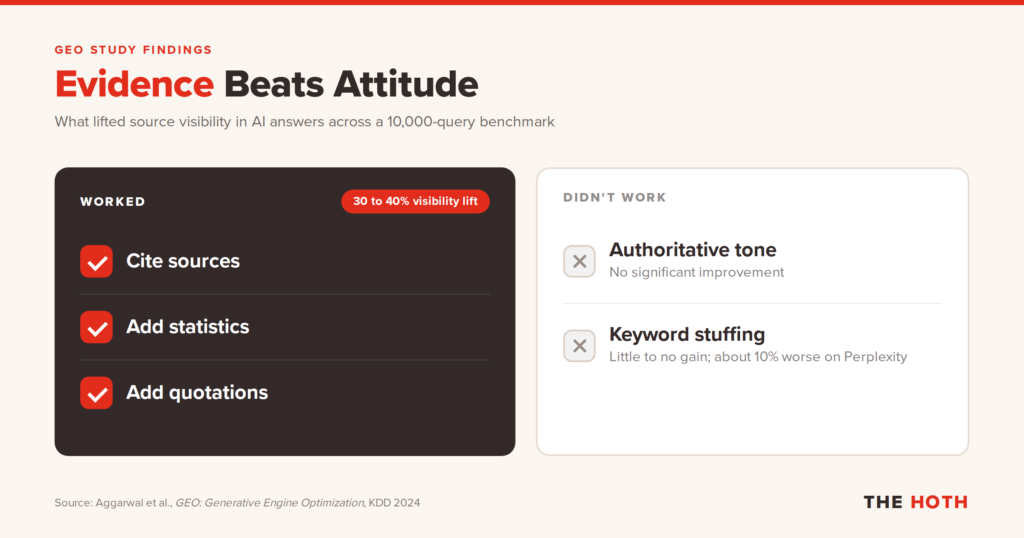
AI answer engines rely on E-E-A-T signals because they need evidence that a source is accurate before repeating it. Research on generative search found that adding cited sources, statistics, and quotations raised a page’s visibility in AI answers by roughly 30 to 40 percent, while a more authoritative tone and keyword stuffing did little.
The clearest evidence comes from GEO: Generative Engine Optimization, a study by researchers from Princeton University and IIT Delhi presented at the KDD 2024 conference. The team built a benchmark of 10,000 queries, tested nine different content changes, and measured how visible each source became in AI-generated answers.
Three changes came out on top: citing credible sources, adding relevant statistics, and including quotations from credible sources. Each lifted visibility by roughly 30 to 40 percent on the study’s main metric. Two other findings matter just as much for E-E-A-T.
Sounding authoritative didn’t work. Rewriting content in a more persuasive, confident style produced no significant improvement. The engines responded to evidence, not attitude.
Keyword stuffing didn’t work either. It produced little to no gain, and when the researchers tested it on Perplexity, it performed about 10 percent worse than leaving the content alone.
One more result is worth knowing if you aren’t the biggest site in your market. Sources ranked fifth in the underlying search results saw a 115.1 percent visibility increase from citing sources alone. Proof does more for the underdog than for the page already on top.
Google points in the same direction. Its AI guide says chasing inauthentic mentions across the web isn’t as helpful as it might seem, because its generative features depend on the same systems that reward quality content and block spam. You can’t shortcut your way into looking trustworthy. You have to show the work.
The Page-Level E-E-A-T Checklist: What Should Every Page Show?
Every page should show who wrote it and why they’re qualified, first-hand detail only someone with real experience could provide, a source for every claim and statistic, and trust basics like contact details, accurate dates, and real reviews. Off-site mentions then confirm what your pages claim.
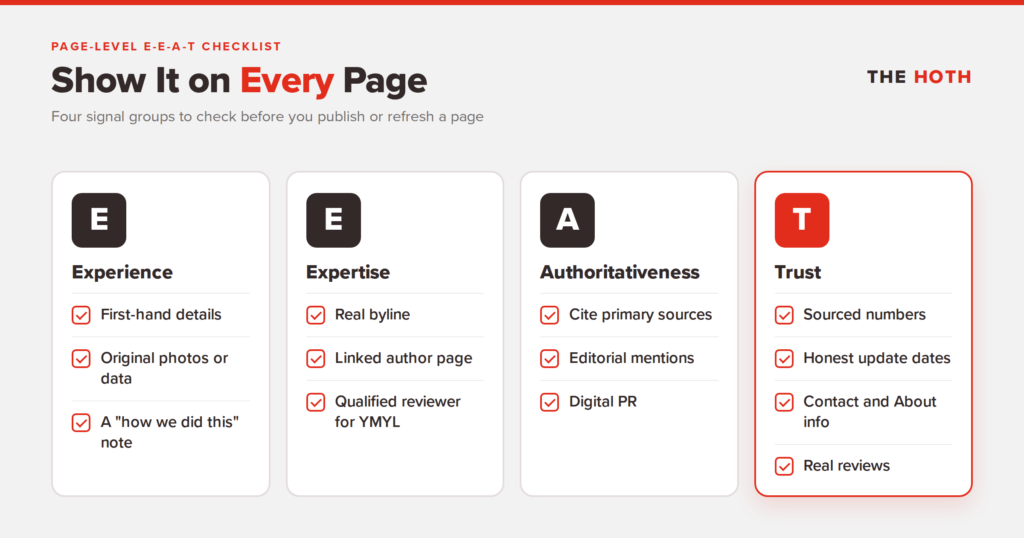
Think of it as a background check. Each letter in E-E-A-T answers a question that a skeptical reader, or a retrieval system, is asking about your page.
Experience: have you done the thing?
Experience is the signal most pages skip, and it’s the one AI can’t fake for you. Google’s AI guide separates commodity content, the kind anyone could write from common knowledge, from non-commodity content built on an expert or first-hand take. A first-hand review offers something a summary of other reviews can’t.
On the page, experience looks like this:
- Specific details from your own work: what you tried, what happened, and what you’d do differently
- Original photos, screenshots, or data instead of stock images
- A short note on how the content was made, which Google calls the “How” of content, such as how many products you tested or where your numbers came from
- Real outcomes with real figures, pulled from your own clients or projects
A quick test: if a paragraph could appear unchanged on a competitor’s site, it isn’t showing experience.
Expertise: is it obvious who wrote this?
Google’s helpful content guidance frames expertise around a “Who” test. Is it self-evident who wrote the content? Do pages carry a byline where readers would expect one? Does that byline lead to real background on the author? Google says it strongly encourages accurate authorship information.
Do this on every page that carries advice or analysis:
- Add a byline with a real name, not “Admin” or “Staff”
- Link the byline to an author page listing credentials, experience, and the topics that person covers
- For medical, legal, or financial content, add a qualified reviewer and say what they reviewed (our YMYL SEO guide covers this in depth)
- Keep author pages consistent with LinkedIn and other profiles, so the same person reads as the same person everywhere
Author schema can help machines connect those dots, but don’t expect it to do the heavy lifting. Google’s AI guide says structured data isn’t required for its generative features and there’s no special markup to add. Schema labels the evidence. It doesn’t replace it.
Authoritativeness: do other sources back you up?
Authority is the one letter you can’t fully control from your own site, because it depends on what others say about you. It has two halves.
The on-page half is citation. Link your claims to primary sources: official documentation, government data, peer-reviewed research, and your own original data. The GEO findings above suggest this helps AI visibility directly, and it shows readers you aren’t guessing.
The off-page half is reputation. Editorial mentions and links from respected publications tell Google and AI engines that other people vouch for you. This is where digital PR and earned media placements carry weight that no on-page edit can match.
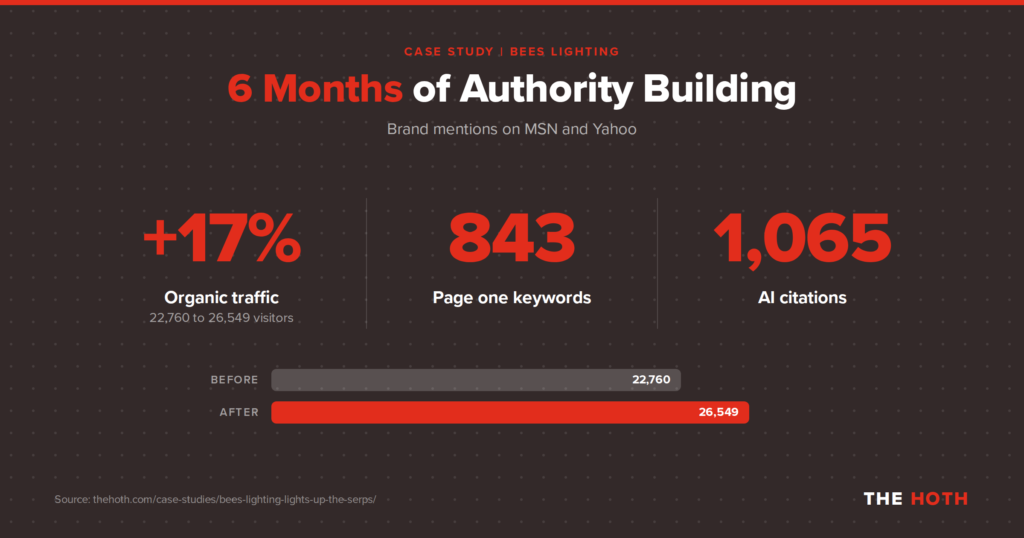
Here’s what that looks like in practice. Bees Lighting, an ecommerce lighting retailer, came to us with 20 years in business and BBB accreditation, but its online signals didn’t reflect either. It was competing with Home Depot and Wayfair for searches like “LED ceiling lights.” We combined targeted link outreach with digital PR that landed contextual brand mentions on MSN and Yahoo.
Within six months, organic traffic grew 17 percent (from 22,760 to 26,549 visitors), 843 keywords reached page one, and the brand picked up 1,065 AI citations. The expertise was always there. The campaign made it visible to the systems deciding who to trust.
For a closer look at how outside mentions build up over time, see the three tiers of brand mentions in AI search.
Trust: is everything on the page believable?
Trust is where Google says the other three letters come together, and it’s the easiest to lose. One unsourced statistic or a suspicious-looking review section can undercut a page that’s otherwise strong.
Check these trust signals on every page:
- Accuracy: every number has a source, and nothing contradicts what that source says
- Honest dates: Google lists changing a page’s date to look fresh, without substantially changing the content, as a warning sign
- Contact and About information that makes it clear who is responsible for the site
- Reviews and testimonials from real customers, with replies from your team
Reviews deserve extra care. The FTC’s final rule banning fake reviews and testimonials, announced in August 2024, prohibits buying or selling fake reviews (including AI-generated ones), paying for reviews that express a particular sentiment, posting undisclosed insider reviews, and suppressing negative reviews. It also lets the agency seek civil penalties. Review shortcuts aren’t just an SEO risk.
Real reviews, managed well, are one of the strongest trust signals a local business has. A Phoenix-area pest control company we work with already held a 4.9-star rating, but its Google Business Profile wasn’t producing many calls. Through our review and reputation management service, the team replied to 97.2 percent of reviews with personalized responses, kept the profile active, and synced the company’s business details across 70+ listing platforms.
Over seven months, from February to August 2025, the profile drew 3,650 views and 568 customer actions, including 116 phone calls and 248 direction requests. The rating held at 4.9 the whole way.
Which Pages Need E-E-A-T Signals the Most?
Every indexable page benefits from E-E-A-T signals, but blog posts, service pages, product pages, and your About and author pages carry the most weight, because they’re the pages AI systems cite and the pages people check before they trust you.
Different page types prove different things. Use this as a quick reference:
| Page type | What it needs to prove | Signals to add |
|---|---|---|
| Blog posts and guides | The writer knows the topic firsthand | Byline, linked author page, first-hand examples, cited sources, an update date that matches a real update |
| Service pages | You deliver the result you sell | Case study results, named team members or credentials, reviews, a clear description of your process |
| Product pages | The product works as described | Original photos, full specs, verified reviews, return and shipping policies |
| About page | You are a real, accountable business | Company story, team, address, contact details, press mentions |
| Author pages | This person is qualified | Credentials, years of experience, published work, links to professional profiles |
| Location pages | You serve this area | Local address, local reviews, examples of local projects |
If your About page is thin, fix it first. It’s the fastest way to answer the question raters are trained to ask about any site: who is responsible for this?
How Do You Audit an Existing Page for E-E-A-T?
To audit a page for E-E-A-T, check who wrote it, whether it includes first-hand detail, whether every claim has a source, whether its date reflects a real update, and whether outside sources confirm your reputation. Then fix the gaps in order of each page’s business value.
Most sites don’t need more content to improve E-E-A-T. They need their existing content to show its work. Here’s the audit we run:
- Start with the pages that matter. Pull your highest-value pages, plus any that have lost traffic. Search Console’s Generative AI performance report shows how your content appears in Google’s AI features, which tells you which pages AI is already using.
- Run the Who, How, and Why test. Is the author obvious? Is it clear how the content was produced? Was it written to help your audience, or mainly to attract search traffic? These are the three questions Google uses in its own guidance.
- Source every claim. Highlight every statistic and factual claim on the page. If it doesn’t link to a primary source or your own data, add the source or cut the claim.
- Add the experience layer. Find one or two spots where first-hand detail can replace generic advice: a client result, a screenshot, a lesson you learned the hard way.
- Fix author information. Use a real byline, link it to an author page, and add a qualified reviewer for YMYL topics.
- Update for real, then date it. Refresh outdated stats, broken links, and sections that no longer match how things work. Change the date only after the content changes.
- Check your off-site reputation. Search your brand name. Look at your reviews, your press mentions, and what AI assistants say about you. Gaps here point to PR and review work, not page edits.
Refreshing an existing page is usually faster than starting over, and you keep the URL’s links and history. If you have dozens of pages to work through, that’s where a repeatable refresh process pays off.
What E-E-A-T Mistakes Cost You AI Citations?
The most common E-E-A-T mistakes are fake or anonymous authors, unsourced statistics, date changes without real updates, bought or filtered reviews, and mass-produced content. Each one weakens the trust AI systems look for before they cite a page.
Inventing experts. An AI-generated headshot with a made-up bio isn’t expertise. If someone checks and the person doesn’t exist, the whole site loses credibility.
Publishing unsourced numbers. A statistic with no source is a liability. If it’s wrong, you’ve handed AI systems an error to repeat, or a reason to skip your page.
Bumping dates. Changing the date without changing the content is a warning sign in Google’s own guidance.
Buying or filtering reviews. Beyond the SEO risk, it can put you on the wrong side of the FTC rule.
Scaling thin content. Google’s AI guide warns that creating separate pages for every variation of a query, mainly to manipulate results, violates its scaled content abuse policy. More pages don’t make a site higher quality.
Chasing fake mentions. Planted forum comments and paid mentions on low-quality sites don’t build the reputation AI looks for, and Google says so directly.
How Can The HOTH Help You Show E-E-A-T?
The HOTH helps brands show E-E-A-T by refreshing existing content with first-hand detail, sources, and AI-ready structure through Content Refresh, and by earning the editorial mentions that build off-site authority through Digital PR.
If your content is solid but doesn’t show its work, HOTH Content Refresh is the fastest fix. Our writers audit an existing post, add at least 50 percent new content, update internal and outbound links, fix broken citations and outdated stats, and restructure it for Google and AI Overviews. Every refresh comes with a changelog showing exactly what changed, so your new date reflects real work.
For the authority half, HOTH Digital PR earns the kind of editorial coverage that moved the needle for Bees Lighting: placements on real publications that AI systems already trust.
Not sure which pages need what? Book a free strategy call and we’ll walk through your site with you.
E-E-A-T SEO FAQs
Is E-E-A-T a Google ranking factor?
Not directly. Google says E-E-A-T itself isn’t a specific ranking factor. Its systems use a mix of signals to identify content with strong experience, expertise, authoritativeness, and trust, and they weigh those signals more heavily on YMYL topics.
Does E-E-A-T matter for ChatGPT and Perplexity, or just Google?
Google has confirmed that its AI features run on its core ranking and quality systems. Other AI assistants don’t publish their criteria, but the GEO study tested its methods on Perplexity and found that adding statistics and quotations improved visibility there too, by up to 37 percent on one measure.
Do I need author schema for E-E-A-T?
It helps machines connect an author to their credentials, but it isn’t required. Google says there’s no special schema you need for its AI features. Visible bylines, detailed author pages, and real credentials matter more than the markup describing them.
Can AI-assisted content still show E-E-A-T?
It can, if the finished page meets the same standard. Google doesn’t ban AI-assisted content, but it expects the work to meet its quality standards and suggests explaining how automation was used where readers would expect it. What AI can’t supply is your first-hand experience, so a human expert still needs to add it.
How long do E-E-A-T improvements take to show results?
There’s no fixed timeline, because it depends on your competition and how much of the gap is on-page versus off-site. On-page fixes can register once Google recrawls the page. Off-site authority takes longer to build: the Bees Lighting results came over a six-month campaign.
Make Every Page Prove It
E-E-A-T now decides more than rankings. It shapes whether AI answers cite you at all. Show who wrote each page, prove first-hand experience, source every claim, keep your trust basics honest, and earn the outside mentions that confirm it.
Start with your five most valuable pages and run the audit above. You’ll probably find the same two or three gaps repeated across all of them, and fixing those once gives you a template for the rest of the site.
If you’d rather hand it off, talk to our team about refreshing your content and building the authority to back it up.