
How to Run a 30-Day AEO Pilot for an Agency Client


A 30-day AEO pilot should answer a practical agency question: can we identify a valuable information gap, improve the underlying answer, and collect enough evidence to decide what to do next?
It should not promise that a client will dominate every AI engine within a month. You control research, publishing, technical work, and reporting. You do not control when a third-party system crawls a page or how every future response will be generated.
The framework below gives a small agency a bounded scope, a schedule, and clear acceptance criteria. The suggested quantities are planning examples, not industry benchmarks or a guarantee of statistical significance.
Agencies without spare delivery capacity can still run the pilot. For a managed delivery option, AEOFAST works around selected questions. Before including it in a client proposal, agree on scope, the questions, approved claims, reporting evidence, and how its work fits your agency’s responsibilities. The agency should be able to explain the engagement clearly to the client.
Define the commercial decision first
Choose one audience and one meaningful buying decision. For a fictional agency-software client, the decision might be whether the product supports collaboration with freelance contractors at an acceptable cost.
Avoid a pilot brief that says only “increase AI visibility.” It can produce a busy month with no useful conclusion.
Write a one-page charter:
| Field | Example scope |
|---|---|
| Audience | Owners of small agencies using contractors |
| Business decision | Evaluate contractor access, cost, and onboarding |
| Question set | Fifteen approved questions in three intent groups |
| Properties | One client website and its relevant public documentation |
| Answer systems | Two agreed systems or modes, with context recorded |
| Content work | Improve three existing pages; create one page only if needed |
| Technical work | Resolve identified blockers within a separate agreed limit |
| Evidence | Baseline and follow-up answers, cited URLs, change log |
| Commercial observation | Relevant referrals and qualified enquiries where measurable |
| Final decision | Continue, narrow, extend observation, or stop |
If the client operates across many countries or products, select one segment for the first pilot. A narrow scope makes the evidence easier to interpret.
Days 1–3: establish access and ownership
Confirm that the agency can inspect the necessary website, analytics, search reporting, and public product information. Request only the access needed for the work.
Assign four responsibilities, even if one person holds several:
- Client fact owner: approves product, pricing, and policy statements.
- Editorial owner: turns verified information into useful pages.
- Technical owner: handles access, publishing, redirects, and metadata.
- Measurement owner: preserves the question set and reports observations consistently.
Record who can authorize publication and how quickly reviews can happen. A pilot with a three-week approval queue needs a different schedule from one with daily access to a product expert.
Use the technical WordPress checklist before committing the writing budget. If priority pages are unavailable or excluded unintentionally, put the corrective work into the charter.
Days 4–7: capture a baseline you can repeat
Build the questions from customer research, sales objections, support themes, and relevant search evidence. Separate discovery questions from brand-specific fact checks.
For each observation, save the exact question, system, mode, date, location or language context, complete answer, and cited URLs. Record failed requests and answers that contain no brand mention.
A manageable illustrative sample might be 15 questions across two systems on two scheduled occasions. That creates 60 answer observations if every request succeeds. It is a directional pilot sample, not a census of how all users experience AI search.
How much can 60 observations show?
Set expectations before the baseline, not after the results. With 60 observations, a 20% mention rate (12 of 60) has an approximate 95% interval of 11.8% to 31.8%. If the follow-up rises to 30% (18 of 60), a standard two-proportion test gives a p-value of about 0.21, which is not a reliable difference. Only a rise to around 40% (24 of 60) reaches the usual 95% threshold, with a p-value of about 0.02.
In plain terms, a pilot of this size can confirm a large shift but not a modest one. That is another reason to anchor the final decision in verifiable work, such as corrected facts, fixed access problems, and pages that now answer the question, rather than in a small change in a sampled rate.
Export the first-party baselines on day 4
Sampled answers are only half of the baseline. Before any change goes live, export:
- The Search Console Performance report and the Generative AI performance report for the pilot pages.
- Bing Webmaster Tools AI Performance, including page-level citations and grounding queries.
- Google Analytics 4 sessions from the AI Assistant channel and from referrals such as
utm_source=chatgpt.com.
Store each export with its date and report name. Search Console turns values shown as “~” or “-” into zeros in downloads, so note any such gaps instead of reading them as real drops. Our measurement guide explains what each report counts and why GA4 places Google’s AI Overview clicks in Organic Search.
Keep exploratory prompts in another sheet. Otherwise, changing questions mid-pilot can make a result look better simply because the later sample was easier.
Use the AI visibility audit checklist for evidence collection and the measurement guide for metric definitions.
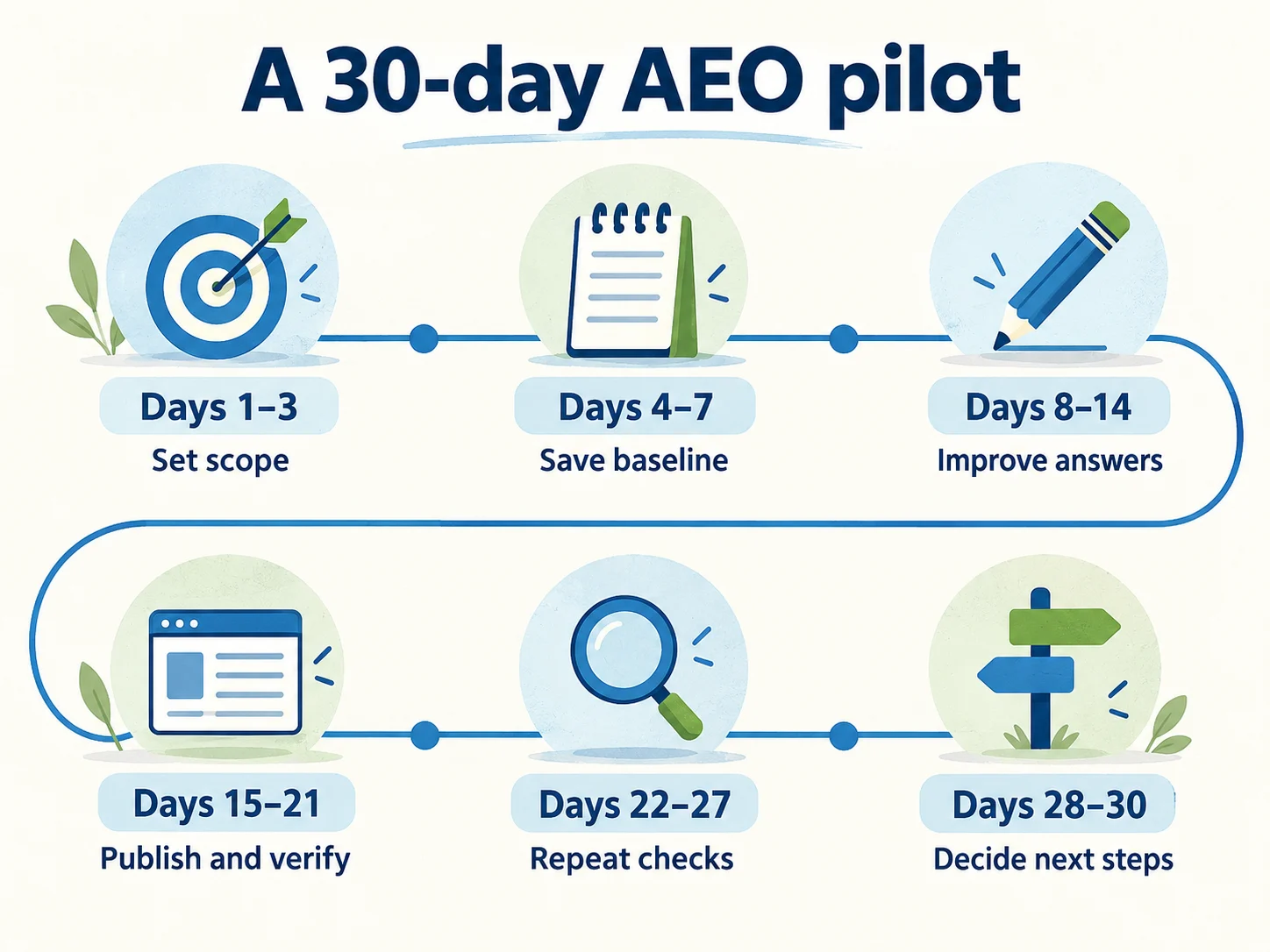
Days 8–14: fix the highest-value answer gaps
Review the baseline alongside the client’s actual pages. Choose changes based on a documented problem.
For the fictional software client, the work could be:
- Add a verified contractor-permissions table to the collaboration page.
- Explain paid-seat conditions with a labeled billing example.
- Update the migration guide to match the current product.
- Link those answers from the comparison and pricing journeys.
Each item needs an acceptance check. “Optimize pricing for AEO” is too vague. “The page explains which contractor roles require a paid seat, and the product owner has checked every row” is testable.
Use an AEO content brief for each material page change. Maintain a dated change log with the original problem, final URL, reviewer, and verification result.
Choose software and services around the work
A small pilot can run with a spreadsheet and a disciplined process. Add a tool when it removes a specific bottleneck.
SurgeGraph can be evaluated for the research and content workflow. Test it using the approved scope and evidence rather than treating an optimization score as the client’s business outcome.
If you include the managed delivery option mentioned at the start of this guide, keep its scope inside the pilot charter so the client can see exactly which questions and deliverables it covers.
Do not sell software access, page production, observed mentions, and acquired customers as if they were the same deliverable. They carry different responsibilities and different levels of control.
Days 15–21: publish and verify the actual pages
Check the public result after publication. Confirm the correct URL, title, description, visible answer, working internal links, and any relevant structured data. Inspect desktop and mobile layouts.
Then verify the practical examples. If an article describes an invitation flow, follow that flow in an appropriate test account. If it explains pricing, compare the calculation with the current approved terms.
Log when the changes became publicly available. If publication slips to day 25, the final report should not imply that an engine had a full month to encounter the new material.
You can notify relevant systems of updates through supported mechanisms where available, but do not represent a submission as proof of crawling, indexing, or AI inclusion. Those are separate observations.
The mechanisms differ by engine:
- IndexNow lets a site announce changed URLs to participating search engines. The IndexNow project lists Bing, Yandex, Seznam, Naver, Yep, the Internet Archive, and Amazonbot among its endpoints; Google is not on that list. Many WordPress SEO and CDN plugins can send IndexNow notifications automatically.
- Google offers “Request indexing” in the URL Inspection tool. Its AI features documentation warns that crawling “can take anywhere from several days to several months”, depending on how often its systems decide a page needs refreshing.
- OpenAI and Perplexity say robots.txt changes take about 24 hours to reach their search systems, but neither publishes a timetable for re-reading changed content.

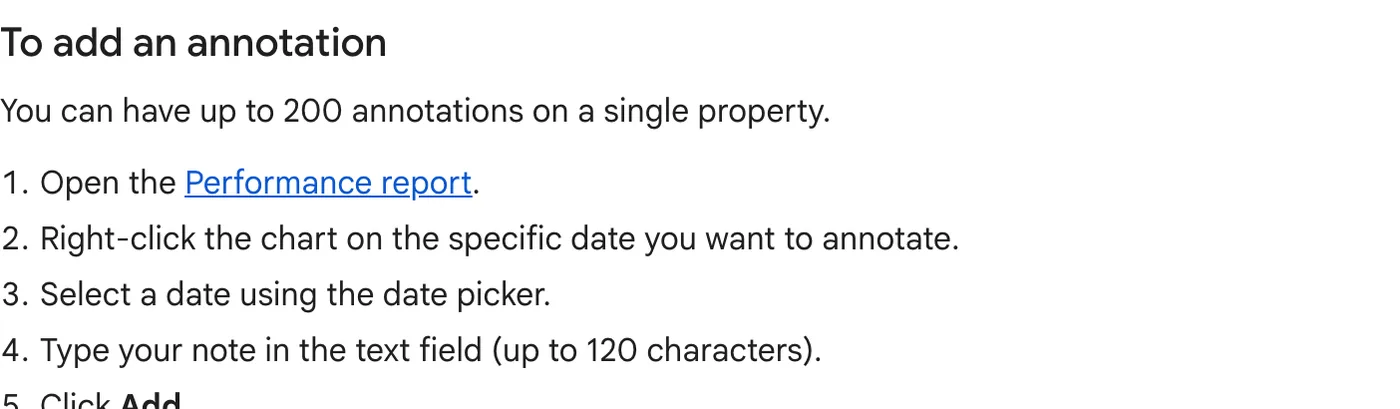
Mark each publication in Search Console with a custom annotation. Annotations appear on the Performance charts for everyone with access to the property; Google allows up to 200 per property and 120 characters each, and advises against including personal information. A dated marker on the chart makes the final review far easier than reconciling a separate change log.
Days 22–27: repeat the agreed checks
Use the same question set and recorded context as closely as possible. Record changes in system behavior or available modes that make comparison less reliable.
Compare at least three things:
- Accuracy: are statements about the client more correct and complete?
- Visibility: do the sampled answers mention the brand or cite its pages?
- Commercial behavior: do relevant visits and qualified actions show a useful signal?
Inspect examples, not just totals. A higher mention rate can coexist with a new factual error. A page can attract fewer visits but more qualified enquiries. The report should preserve those distinctions.
If you keep a small set of unchanged questions or pages for context, explain that it is only a rough comparator. It does not automatically create a controlled experiment, because the question groups and external conditions may differ.
Days 28–30: make a decision, not a victory slide
Use a decision table agreed before the final review:
| Evidence at the end | Reasonable next step |
|---|---|
| Important facts are corrected and relevant observations improve | Continue with the next comparable question group |
| Pages are stronger, but answer visibility is unchanged | Extend observation or investigate source selection before scaling |
| Technical access still fails | Resolve the blocker before more content production |
| Mentions rise but are irrelevant or inaccurate | Revise targeting and claims; do not celebrate the count |
| No buyer relevance or practical benefit emerges | Stop or redefine the program |
A pilot can be worthwhile even when the decision is to stop. Discovering that the chosen questions have little commercial value is better than disguising that finding with more publishing volume.
Hand over a reusable evidence pack
Give the client the approved question set, baseline and follow-up observations, published URLs, claim approvals, change log, metric definitions, and a list of unresolved issues with owners.
Separate completed work from observed outcomes and hypotheses. For example:
Completed: three verified page updates. Observed: more sampled answers linked to the permissions guide. Unproven: whether those updates caused the change or increased sales.
That distinction makes the next budget decision easier. A useful 30-day AEO pilot leaves the client with better information, better pages, and a clearer choice about what deserves another month of work.
Questions agencies commonly ask
Is 30 days long enough?
Long enough to fix facts, improve pages, and collect a first comparison; often too short to see the full effect, because recrawling can take weeks. Present day 30 as a decision point, with “extend observation” as a legitimate outcome, rather than as the end of measurement.
Should the pilot be paid?
A paid pilot with a fixed scope usually produces better client engagement and faster approvals than a free trial. Price the work you control, such as research, page changes, technical fixes, and reporting, not an AI visibility result.
What if the client wants a guaranteed citation?
Decline the guarantee and explain why. No agency or tool controls how an AI system selects sources. Offer guaranteed deliverables and transparent evidence instead.