
How Practices Get Found in Google and AI Search

Dental SEO is the work of making your practice the one Google and AI assistants surface when someone nearby needs a dentist. It comes down to five things: a complete Google Business Profile that wins the local pack, a website with a dedicated page for every procedure you want to grow, a steady flow of real patient reviews handled in a HIPAA-compliant way, the trust signals Google demands from health content, and enough authority that AI assistants have a reason to recommend you by name.
Someone chips a molar on a Saturday, opens their phone, and types “emergency dentist near me.” Someone else has been putting off an implant consultation for a year and finally asks ChatGPT which practice in their city does full-arch cases. A parent searching for a pediatric dentist that takes new patients scans the three names in the map pack and calls the one with 400 reviews.
None of those people scrolled to page two. Most never left the first screen. Dental searches carry more booking intent than almost any other local category, and the practices that show up in the local pack, the organic results, and the AI answer win the appointment before a competitor knows the call was made.
That is why “dental seo” costs about $25 per click in paid search. Practices pay that because a single new implant or aligner patient covers a lot of clicks. The organic version of that visibility compounds instead of expiring, and it now works across Google, Maps, AI Overviews, and the AI assistants patients increasingly ask for a recommendation.
This guide walks through how each of those channels decides which practice to show, what a dental website needs in order to rank for the procedures that drive revenue, how to grow reviews without a HIPAA problem, and what real dental clients have seen from doing this consistently.
What is dental SEO, and why is it different from generic local SEO?
Dental SEO is local SEO plus three complications: multiple high-value service lines with very different patient intent, a review-driven conversion path that is regulated by HIPAA, and health content that Google holds to a higher trust standard. A plumber has one service and one intent. A dental practice might be competing for hygiene patients, implant cases, and clear aligner consultations at the same time, each with its own keywords, pages, and competitors.
Generic local SEO advice tells you to claim your Google Business Profile, collect reviews, and put your city name on the homepage. That is table stakes for a dental practice, not a strategy. A general dentist trying to fill hygiene chairs is playing a different game than the same practice trying to rank for “dental implants cost” or “Invisalign near me,” and the content depth, link profile, and even the Google Business Profile categories need to reflect the procedures you want more of.
The second complication is trust. Google treats topics that can affect someone’s health or finances as “Your Money or Your Life” content, and its helpful content documentation says its systems give even more weight to experience, expertise, authoritativeness, and trust for those topics. A page explaining sedation options or implant recovery is YMYL content whether you think of it that way or not.
The third is that dental practices lose patients on the review step in ways other businesses cannot. Responding to a bad review with a patient’s treatment details is a federal privacy violation, and practices have paid for exactly that mistake. We cover the compliant version below. If you want the broader picture of how health, legal, and finance sites earn rankings and AI citations under the higher bar, our YMYL SEO guide goes deep on it.
Why does the local pack decide which practice gets the call?
Google ranks local results on relevance, distance, and prominence, according to its own Google Business Profile ranking documentation. Relevance is how well your profile matches the search, distance is how far you are from the searcher, and prominence is how well known you are, measured partly by how many sites link to you and how many reviews you have. You cannot change distance. You can change everything else.
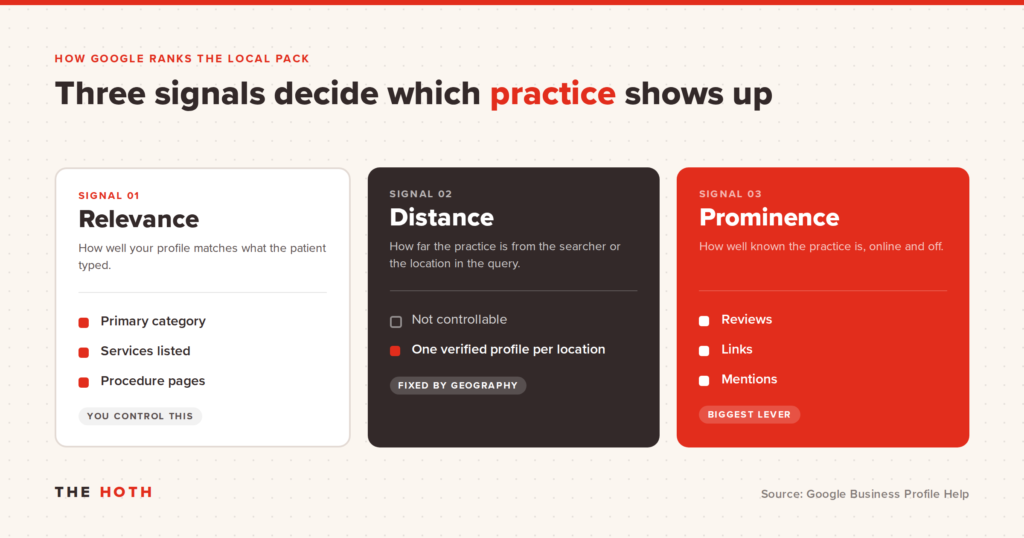
The local pack is the block of three businesses with a map at the top of most “dentist near me” searches. It sits above the organic results, shows ratings and review counts, and on mobile it takes most of the screen. For a dental practice, it is the most valuable real estate in search.
Google says there is no way to request or pay for a better local ranking, and it lists the things that help: verify the business, keep hours and address accurate, choose the right category, add photos, and respond to reviews. Our Google Business Profile guide walks through setup and optimization step by step. For a dental practice, the details that matter most are:
- Primary category. “Dentist” is the default, but a cosmetic-focused practice, an orthodontist, an oral surgeon, or a pediatric dentist should set the primary category that matches the procedures they want to grow, then add secondary categories for the rest.
- Services and procedures. Google lets you list services on the profile. List every procedure you want patients to find you for, with short descriptions that use the words patients use, like “dental implants,” “teeth whitening,” and “emergency dental care.”
- Photos of the actual practice. Exterior, reception, operatories, the team. Stock photos of a smiling model do nothing for prominence or trust.
- Consistent name, address, and phone across every directory that lists you, including dental-specific directories and insurance provider lookups. Conflicting listings confuse Google about which business is real and where it is.
Multi-location groups and DSOs need one verified profile per location, each with its own service list, photos, and review stream, and each linked to a location page on the website that is not a copy of the others. Our local SEO ranking factors chapter covers the signals in more depth, and the HOTH Local SEO services team handles the citation and profile work for practices that would rather not.
How should a dental website be structured to rank for procedures?
Every procedure you want to grow needs its own page, written for the patient who is deciding whether to book, not for a search engine. One page per service beats one “Services” page with a paragraph each, because Google ranks pages, not businesses, and a patient searching “dental implants” wants an implant page, not a menu.
This is where most dental websites break down. They have a beautiful homepage, a doctor bio, and a single services page that lists twelve procedures in bullet form. Google has nothing specific to rank for “root canal,” “veneers,” or “sedation dentistry,” so it ranks a competitor or a national directory instead.
A procedure page that ranks answers the questions a patient has before they book. What the procedure is and who it is for. What it costs, or at least the range and what changes it. What recovery looks like. Whether insurance covers it. What the alternatives are. Who on your team performs it and what their training is. Real before-and-after photos where appropriate, with consent.
That last point matters more than it used to. Google’s guide to generative AI features in Search draws a line between commodity content, the kind of generic “7 tips” article anyone could have written, and non-commodity content built on first-hand expertise. A page about implant candidacy written from your surgeon’s experience, with your pricing and your process, is the second kind. It is also the kind AI systems prefer to cite.
The structure that works for a single-location practice looks like this:
- Homepage: who you are, where you are, what you specialize in, and a clear path to book.
- One page per procedure or service line, grouped under a services hub. Implants, aligners, cosmetic, pediatric, emergency, and so on.
- Doctor and team pages with credentials, education, specialty certifications, and years in practice. These are trust pages, and Google reads them that way.
- A patient information section: insurance and financing, what to expect at a first visit, FAQs.
- A blog or resource section that answers the questions patients ask before they call, written by or reviewed by a clinician.
Multi-location groups add one location page per office, each with its own address, hours, team, photos, and embedded map, and each linking to the procedure pages.
This is the model The HOTH used for a seven-location oral surgery group in the Southwestern United States. When the practice enrolled in our managed SEO program in January 2019, the site was getting about 200 visitors a month, ranked for roughly 600 keywords, and had around 30 backlinks. The campaign built out procedure and treatment content around terms patients were already searching, like anesthesia for tooth extraction and snap-in dentures, added web copy on the service pages, and layered link outreach on top. At the campaign’s peak the site was drawing more than 3,000 visitors a month, a 1,400% increase, and ranking for 5,300 keywords.
The technical side is mostly hygiene: the site loads fast on a phone, every page is crawlable, and the booking button works. Google has said its AI features rely on the same crawling and indexing as regular search, so a page that cannot be indexed cannot be cited either.
How do reviews affect dental SEO, and how do you stay HIPAA-compliant?
Reviews feed prominence, which is one of the three local ranking factors, and they are the first thing a patient reads before choosing between the three practices in the local pack. The practices that win here ask every patient for a review at the right moment, respond to every review, and never put a word of patient information in a public reply.
Google states directly that more reviews and positive ratings can improve a business’s local ranking. That makes review generation an SEO activity, not just a reputation one. The mechanics are not complicated: ask at checkout or in a follow-up text within a day of the visit, link straight to the Google review form, and make it a standing part of the front-desk workflow rather than a campaign you run twice a year. Our Review and Reputation Management service builds that system for practices that want it done for them.
Two rules keep this from going wrong. The first is federal advertising law. The FTC’s final rule on consumer reviews and testimonials, in effect since October 2024, prohibits buying or selling fake reviews, offering incentives conditioned on the review being positive, and suppressing negative reviews through threats or by hiding them while claiming the visible ones represent all feedback. Practices can ask for reviews. They cannot pay for five stars.
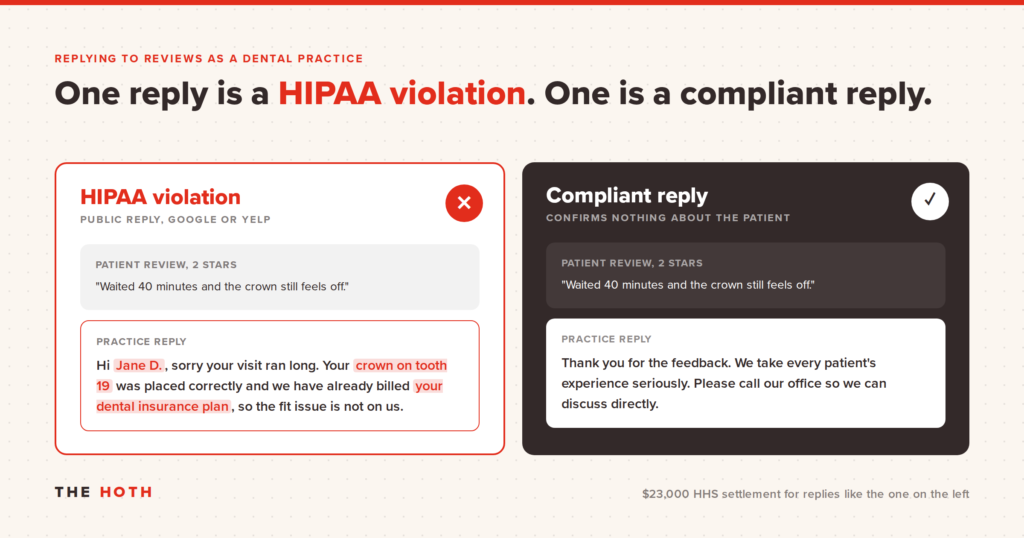
The second rule is HIPAA, and it is where dental practices get burned. A California dental practice paid $23,000 to settle with the HHS Office for Civil Rights after responding to Yelp reviews with patients’ full names and details about their visits and insurance, information the patients had not even included in their own reviews. It was not the only enforcement action of its kind. Under HIPAA, confirming that a reviewer is a patient at all is a disclosure.
The compliant response to a negative review is short and generic: thank the person for the feedback, say the practice takes patient experience seriously, and invite them to call the office directly to discuss. No treatment details, no dates, no “as we explained during your visit.” Train whoever manages the profile on this, and put it in writing.
What trust signals do dental pages need to rank as health content?
Google’s ranking systems look for experience, expertise, authoritativeness, and trust, and its people-first content guidance says trust is the most important of the four. For a dental website that means named clinical authors with credentials, clear sourcing for any medical claim, an About page that establishes who runs the practice, and content that reads like it was written by someone who has performed the procedure.
Google’s documentation frames this as “who, how, and why.” Who created the content, and can a visitor see that? How was it produced, and is that disclosed where a reader would expect it? Why does it exist, and is the answer “to help patients” rather than “to rank”? Those three questions are a useful audit for every page on a dental site.
In practice, the trust signals that move the needle for a dental practice are:
- Author bylines on clinical content, with a link to the dentist’s bio page showing degree, school, board certifications, and specialty training.
- A “medically reviewed by” line on patient education content the dentist did not write personally.
- Citations to primary sources, such as the American Dental Association or peer-reviewed research, when a page makes a clinical claim.
- Real photos of the team and the office, not stock imagery.
- Transparent pricing or price ranges, financing options, and insurance information. Vagueness reads as evasion.
- Consistent business details everywhere, so the practice Google sees on the website matches the one on the profile and in every directory.
How do backlinks and authority fit into dental SEO?
Backlinks from relevant, authoritative sites tell Google and AI systems that other people vouch for your practice. Google names links as one of the inputs to local prominence, and in competitive metros the difference between the practice in the local pack and the one on page two is often authority, not on-page work.
Most dental practices have almost no backlinks beyond directories, which is why a focused link building effort tends to produce outsized results. The links that matter come from health and lifestyle publications, local news and community sites, dental industry outlets, and the kinds of pages that explain a procedure and point to a practice that performs it.
A Texas orthodontics practice specializing in clear aligners is a good example. Over roughly nine years the practice had accumulated around 140 backlinks. In the six months after The HOTH built a coordinated campaign of blog content and link outreach, that grew to about 640, a 357% increase. Ranking keywords rose from 1,400 to more than 4,000 over a similar window, and monthly visitors went from roughly 3,000 to more than 10,000.
The authority you build this way is not only a Google signal. The same links and mentions are what AI assistants use to decide whether a practice is established enough to recommend, which is the next piece. The HOTH Link Outreach service places these links for practices as a standalone product or as part of a managed campaign.
How do AI assistants decide which dentist to recommend?
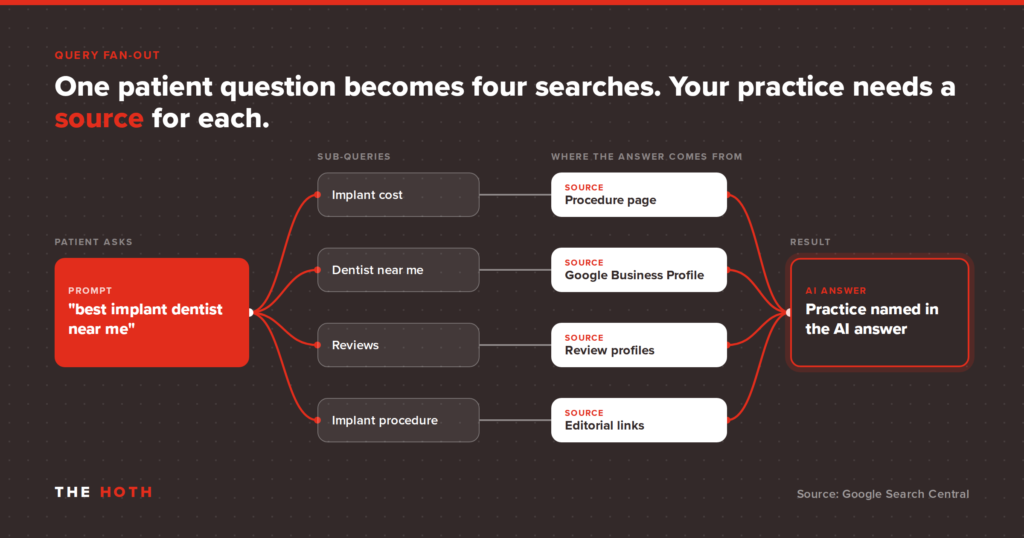
AI assistants recommend practices they can find, verify, and cite. Google’s official guidance on generative AI features says AI Overviews and AI Mode are grounded in its core search index, use “query fan-out” to run several related searches behind a single question, and can pull local business details straight from Google Business Profiles. In other words, the practice with the strongest local profile, the clearest procedure pages, and the most authority is the one the AI answer names.
Google is unusually direct about this. Its documentation says there are no additional requirements to appear in AI Overviews or AI Mode, that “AEO” and “GEO” are still SEO from its perspective, and that site owners can ignore a list of supposed hacks: llms.txt files, chunking content into fragments, rewriting pages “for AI,” and chasing inauthentic mentions. What it recommends instead is unique, expert-led content, a clean technical foundation, and a maintained Google Business Profile so local details can surface in AI responses.
For a dental practice, that translates into a short list:
- Answer the questions patients ask AI assistants, on your own site, in your own words. “How much do implants cost in [city],” “is sedation safe for someone with anxiety,” “what is the difference between veneers and bonding.” Each of those is a fan-out query waiting to land on a page you own.
- Keep the Google Business Profile complete and current, because that is the record AI features consult when a query has local intent.
- Build the third-party footprint. Reviews, local press, directory listings, and editorial links are how an AI system verifies that a practice is real, established, and well regarded before it puts your name in an answer.
- Track it. Google Search Console now reports performance in generative AI features separately, so you can see whether the work is showing up.
ChatGPT, Perplexity, and the other assistants do not publish equivalent documentation, but our tracking across client campaigns points the same direction: the sites that earn citations are the ones with authority, specific content, and a verifiable presence. There is no dental-specific AI trick, and anyone selling one should be asked for their data. AI Discover is how The HOTH tracks and grows AI citations for clients alongside the search work.
What should a dental practice do first?
Start with the Google Business Profile and the review workflow, because they produce results fastest. Then build out procedure pages for your two or three highest-value service lines. Then invest in authority. Most practices that follow that order see local pack movement within a few months and meaningful organic growth within six to twelve.
A realistic first 90 days looks like this:
Weeks 1 to 2: Fix the foundation
Verify and complete the Google Business Profile for every location. Set the right primary category. Add services, photos, and hours. Audit directory listings for mismatched addresses and phone numbers and fix them. Set up Google Search Console and Google Analytics if they are not already running.
Weeks 3 to 4: Turn on reviews
Write the request script, build the follow-up text, and train the front desk. Write the compliant response templates and assign one person to reply to every review within two business days. Confirm nobody with profile access has ever posted patient details, and clean up any reply that did.
Weeks 5 to 10: Build procedure pages
Pick the service lines with the highest case value and write a full page for each. Have the treating dentist review and byline them. Add pricing ranges, recovery expectations, and insurance details. Interlink them with the homepage and location pages.
Weeks 11 to 13: Start earning authority
Begin a monthly link building cadence aimed at health and local publications. Publish one or two patient-question articles a month, written to be cited. Check the Search Console generative AI report and the local pack rankings for your core terms, and set the baseline you will measure against.
How does The HOTH run dental SEO?
Through HOTH X, our managed SEO program, a dental practice gets a dedicated campaign manager who builds the strategy around the procedures you want to grow and runs the local, content, link, and review work every month. There is no à la carte guessing and nothing for the practice to manage.
The oral surgery group and the orthodontics practice above were both HOTH X clients. The program combines the pieces this guide covers: Google Business Profile and citation work, procedure-level content written and reviewed for a clinical audience, monthly link outreach from health and lifestyle publications, review acquisition with HIPAA-compliant response handling, and AI visibility tracking. Practices of every size use it, from single-location family dentists to multi-site DSOs, and our dental SEO solutions page shows how we tailor it to the vertical.
Dental SEO FAQ
How long does dental SEO take to work?
Google Business Profile and review improvements can move local pack rankings within one to three months. Organic rankings for procedure pages typically take three to six months to establish and six to twelve months to become a reliable patient source. The oral surgery group in this article saw steady growth for a year before its traffic spiked.
How much does dental SEO cost?
Managed dental SEO programs generally run from a few thousand dollars a month for a single location to considerably more for multi-location groups, depending on market competitiveness and how many service lines are in scope. One new implant or aligner patient a month covers most of that range, which is why the “dental seo” keyword commands roughly $25 per click in paid search.
Can I respond to a negative Google review as a dentist?
Yes, but the reply cannot contain any patient information, including confirmation that the reviewer is a patient. Thank them, state that you take feedback seriously, and invite them to contact the office. Practices have paid five-figure HIPAA settlements for replies that included treatment or insurance details.
Do I need a separate strategy for AI search?
No. Google has stated that its AI features draw on the same index and ranking systems as regular search, and that no special files, markup, or “AI-optimized” writing are required. The work that earns you the local pack and organic rankings is the same work that gets you named in AI answers. What changes is measurement, which now includes AI citations alongside rankings and traffic.
The Practices That Show Up Everywhere Win
Dental SEO in 2026 is not a separate list of tricks for Google, Maps, and AI. It is one set of fundamentals, done well and done consistently: a complete profile that wins the local pack, a page for every procedure worth growing, a review engine that runs itself and stays compliant, trust signals that satisfy the health-content bar, and enough authority that an AI assistant is comfortable putting your name in its answer.
The practices in this article did not find a shortcut. They ran the whole system for long enough to compound, and their traffic, rankings, and patient volume followed. If you want to see what that would look like for your practice, book a call with The HOTH and we will map it out against your market and your service lines.