
B2B Social Media Marketing in 2026: Trends, Strategies & Success

B2B social media marketing has hit a turning point. Having worked in B2B sales since 1995 and the B2B social space since 2008 when I launched my blog (and later wrote my first LinkedIn book in 2009), I’ve seen plenty of shifts. But the changes coming in 2026? They’re different.
The convergence of AI, evolving buyer demographics, and platform dynamics is creating opportunities we haven’t seen before. And challenges too.
Here’s why I’m paying close attention: As a Fractional CMO working with companies on their digital strategies, teaching at universities, hosting a podcast, and running a YouTube channel, I’m seeing these trends play out in real time across dozens of organizations. My six books on social media marketing, including Maximizing LinkedIn for Business Growth, have covered the evolution of this space, but what’s coming next requires a fresh playbook.
Key Takeaways
✅ LinkedIn dominates B2B, with 96% of B2B marketers including it in their digital strategy and 80% of B2B social leads originating from the platform.
✅ Video is now the default format. 90% of B2B buyers prefer video content when learning about products and services.
✅ Millennials and Gen Z make up 65-73% of B2B decision-makers, fundamentally changing content expectations.
✅ AI adoption is accelerating, with 85% of B2B marketers using AI tools for content creation.
✅ Employee advocacy programs deliver 8x more engagement than brand-only posts.
✅ First-party data collection through social media becomes essential as third-party cookies disappear.
What Is Driving B2B Social Media Marketing Changes in 2026?
B2B social media marketing in 2026 is defined by three forces: generational shifts in buying committees, AI integration across every workflow, and the rise of video as the primary content format. Companies that adapt to these changes will gain significant competitive advantages in lead generation and brand building.

The data backs this up. 75% of B2B buyers now use social media in their purchasing decisions, according to DemandSage’s 2025 research. That’s not a marketing nice-to-have. That’s a strategic necessity.
And if you look at your LinkedIn newsfeed lately, you’ve probably noticed something. The line between “personal” and “professional” social media has basically disappeared. Business professionals expect the same engagement quality, personalization, and content standards they get as consumers.
Companies clinging to outdated approaches? They’re becoming irrelevant to their target audiences. I’ve seen it happen to clients who waited too long to adapt.
Which Social Media Platforms Matter Most for B2B Marketing in 2026?
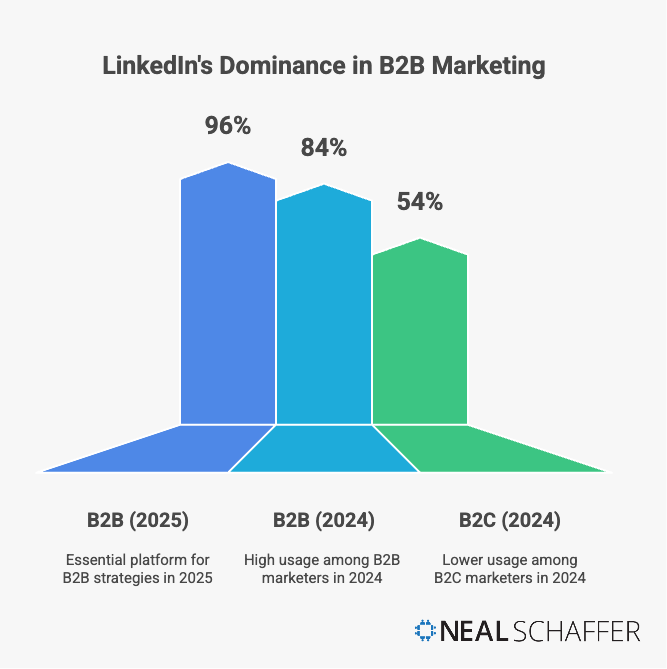
LinkedIn remains the dominant B2B platform, with 96% of B2B marketers incorporating it into their digital marketing strategies. The platform drives up to 80% of all B2B social media leads, making it essential for any serious B2B marketing effort.
The numbers tell a clear story. 84% of B2B marketers used LinkedIn to market their businesses in 2024, compared to just 54% of B2C marketers. LinkedIn isn’t just popular. It’s where B2B actually happens.
This echoes what I’ve written about in my book Maximizing LinkedIn for Sales and Social Media Marketing. LinkedIn has consistently strengthened its position while other platforms struggle to gain real B2B traction.
B2B Platform Comparison for 2026
| Platform | Current B2B Usage | 2026 Outlook | Primary B2B Opportunity |
|---|---|---|---|
| 96% of B2B marketers | Continued dominance | AI-powered targeting, thought leadership | |
| YouTube | 63% of B2B marketers | Growing importance | Short-form educational content |
| TikTok | Emerging adoption | Significant growth | Authentic behind-the-scenes content |
| 57% of B2B marketers | Declining B2B relevance | Targeted group engagement |
Why LinkedIn Still Wins for B2B
LinkedIn’s strength comes from trust. Half of all B2B buyers use LinkedIn as a resource when making purchasing decisions. That’s research behavior, not just social scrolling.
With LinkedIn driving 65% of B2B client acquisitions, the platform remains essential for companies looking to grow their client base. The advertising and lead generation tools keep improving too, with increasingly precise targeting options.
For 2026, expect LinkedIn to enhance its AI capabilities even further. The companies that master these tools will see real competitive advantages. I’ve written extensively about LinkedIn marketing strategy if you want to go deeper on this.
What About Emerging Platforms?
Don’t ignore these platforms entirely, but be strategic about where you invest:
Is Your LinkedIn Working?
Just released: my new book to help professionals, entrepreneurs, and business owners maximize LinkedIn for real growth.
With years of LinkedIn expertise, Maximizing LinkedIn for Business Growth offers actionable steps to build your brand, expand your network, and drive results.
Start leveraging LinkedIn like never before—grab your copy now! Click the cover or button below to buy on Amazon.

TikTok is moving beyond consumer content into professional education and thought leadership. Some B2B brands are seeing real traction here with authentic, behind-the-scenes content.
YouTube Shorts provides quick, educational content for busy professionals. Check out my guide on YouTube Shorts for business if you’re considering this channel.
Specialized industry platforms are gaining importance, especially in regulated industries where vertical-specific networks offer compliance-friendly environments.
The diversification of platforms means you need a more strategic approach to resource allocation. Understanding the various types of social media marketing becomes crucial in this multi-platform environment.
How Is Video Transforming B2B Social Media in 2026?
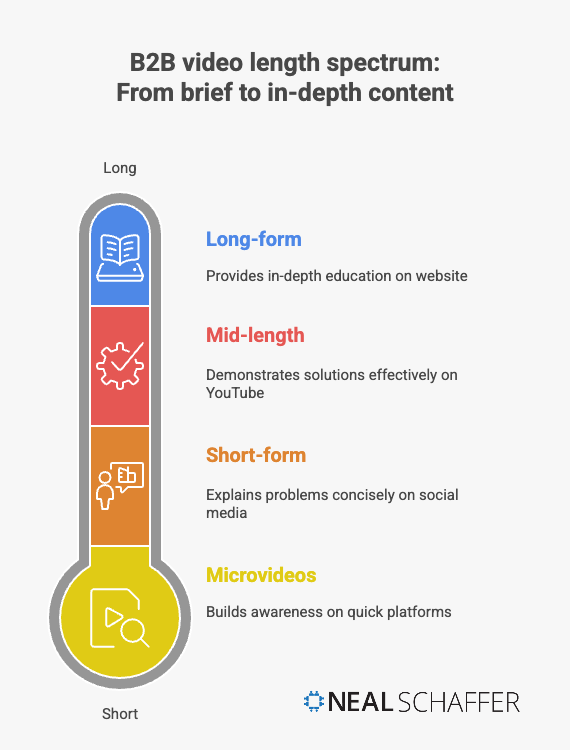
Video is now the default content format for B2B communication. 90% of B2B buyers prefer video content as the best way to learn about products and services. By 2026, video won’t be optional for serious B2B marketers.
The ROI speaks for itself. 52% of B2B marketers cite video as their highest ROI content format, according to Vidico’s research.
But here’s what’s changing: the style, length, and purpose of B2B video content.
Why Short-Form Video Matters for B2B
Think about who’s making B2B purchasing decisions now. Millennials make up 73% of all B2B buyers and 44% of final purchasing decision-makers, according to LinkedIn’s 2025 B2B Buyer Report.
And millennials and Gen Z together represent 65% of B2B decision-makers. For these buyers, “video” increasingly means short-form video.
Even LinkedIn acknowledges this reality, creating a separate “Video” tab on their mobile app. The shift toward brevity reflects modern attention spans. Executives value content that delivers maximum insight with minimum time investment.
I’ve covered this topic in depth in my piece on short-form video types you can use in your marketing.
Video Format Strategy for 2026
| Video Format | Optimal Length | Primary Purpose | Best Platform Fit |
|---|---|---|---|
| Microvideos | 15-30 seconds | Awareness building | LinkedIn, TikTok |
| Short-form | 30-90 seconds | Problem explanation | LinkedIn, YouTube Shorts |
| Mid-length | 2-5 minutes | Solution demonstration | LinkedIn, YouTube |
| Long-form | 10+ minutes | In-depth education | YouTube, Website |
The rise in short-form content doesn’t eliminate the need for longer videos. It creates a more strategic approach where video length matches buyer journey stage and platform context.
How Video Fits the B2B Buyer Journey
In 2026, different video types serve specific functions at each buying stage:
Awareness Stage: Brief thought leadership videos establishing your credibility. Think 30-60 second takes on industry trends or common problems.
Consideration Stage: Problem-solution explainers with specific use cases. Show how your approach differs from alternatives.
Decision Stage: Product demonstrations and customer testimonials. Let satisfied customers tell your story.
Retention Stage: Educational content and advanced feature tutorials. Help existing customers get more value.
An overwhelming 93% of marketers plan to increase their video spending, according to HubSpot’s marketing statistics. This will intensify competition for viewer attention, making quality and strategic distribution even more important.
For practical guidance, check out my article on creating engaging video content for social media.
How Is AI Changing B2B Social Media Marketing?
AI is transforming B2B social media in two critical areas: audience targeting and content creation. By 2026, AI will be integrated into nearly every aspect of B2B social media strategy, from identifying prospects to optimizing post timing.
The adoption rate is accelerating fast. 85% of B2B marketers now use AI tools for content creation, according to Mailmodo’s 2025 research. That’s not early adopters anymore. That’s mainstream.
AI Applications Transforming B2B Marketing
| AI Application | Business Impact | 2026 Adoption Forecast |
|---|---|---|
| Predictive Audience Matching | High | Widespread |
| Intent Data Analysis | Very High | Growing Rapidly |
| Real-time Content Personalization | High | Mainstream |
| Cross-platform Audience Insights | Medium | Nearly Universal |
These AI applications enable targeting precision that wasn’t possible even two years ago. B2B marketers can now deliver the right message to the right decision-maker at exactly the right moment in their buying journey.
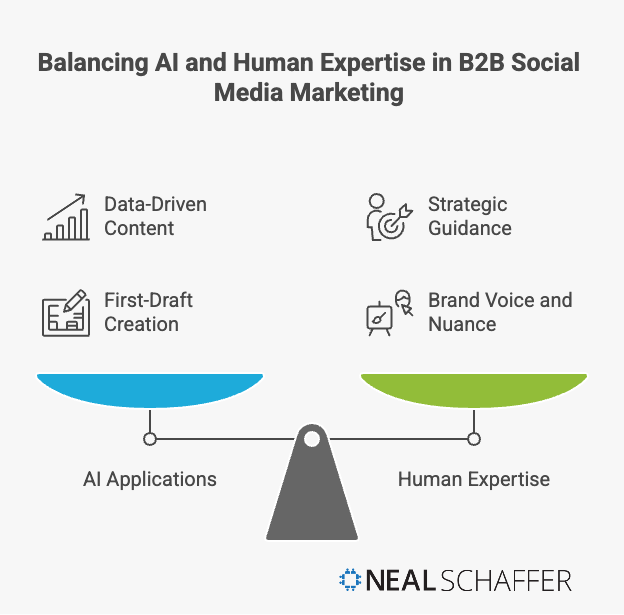
How should you approach AI for content creation? The answer lies in balancing automation with human expertise.
Balancing AI and Human Expertise
A significant portion of marketers now view AI as essential for content creation, per HubSpot’s State of Marketing Report. But that doesn’t mean full automation.
In 2026, the winning B2B social media strategies blend AI-generated content with human creativity and industry expertise. Here’s how I recommend approaching it:
Use AI for: Data analysis and content optimization. Let AI determine what topics and formats will likely perform best based on historical performance and competitive analysis.
Use AI for: First-draft content creation. Generate initial content versions quickly and at scale, then refine.
Keep humans for: Strategic guidance. Industry insights and strategic direction require human judgment and experience.
Keep humans for: Brand voice and nuance. AI can write competently, but it can’t capture your distinctive voice without human editing.
I’ve explored this topic extensively in my piece on AI in digital marketing. Companies using an effective AI strategy will outpace competitors in both content volume and engagement rates while maintaining their distinctive brand voice.
Why Does Social Selling Matter More Than Ever in 2026?
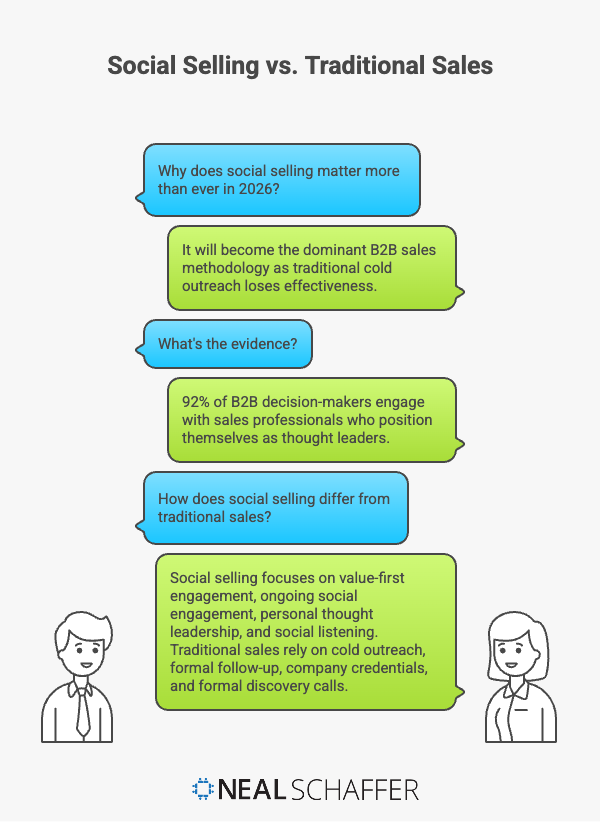
Social selling, the practice of using social networks to find, connect with, understand, and nurture prospects, will become the dominant B2B sales methodology by 2026. Traditional cold outreach is losing effectiveness as buyers increasingly research vendors independently.
The evidence is compelling. 92% of B2B decision-makers engage with sales professionals who position themselves as thought leaders in their industry, according to GaggleAMP’s research on employee advocacy.
That statistic alone should change how you think about sales team social media presence.
Social Selling vs. Traditional Sales Approaches
| Element | Traditional Sales | 2026 Social Selling Approach |
|---|---|---|
| Initial Contact | Cold outreach with sales pitch | Value-first engagement on prospect’s content |
| Relationship Building | Formal follow-up calls and meetings | Ongoing social engagement and content sharing |
| Credibility | Company credentials and client lists | Personal thought leadership and expertise sharing |
| Needs Assessment | Formal discovery calls | Social listening and digital behavior analysis |
This shift emphasizes relationship-building over immediate transactions. The sales professionals who build genuine connections through content and engagement will consistently outperform those relying on cold outreach alone.
Optimizing B2B Social Advertising ROI
Social advertising budgets keep growing. Global social media ad spend will reach approximately $242 billion in 2025, with continued growth into 2026, according to Magna’s global advertising forecast.
To maximize ROI in this competitive environment, B2B marketers need to:
- Implement advanced segmentation using first-party and intent data
- Create platform-specific creative that matches each channel’s content expectations
- Use AI for continuous campaign optimization
- Develop attribution models that accurately track influence across channels
- Balance brand awareness and performance objectives in campaign design
The most successful B2B advertisers integrate paid strategies with organic content and social selling, creating a consistent experience for prospects across all touchpoints.
How Do You Build Authentic Presence in B2B Social Media?
Authenticity cuts through the noise in 2026’s content-saturated B2B environment. As content volume increases, genuine human connections become even more valuable for building trust and driving purchasing decisions.
Companies that develop a culture of authentic social engagement among employees will see significant advantages in reach, engagement, and conversion rates.
Executive Thought Leadership Requirements
Executive visibility on social platforms is now essential for building trust with B2B buyers. And this isn’t just about the CEO. The entire leadership team needs to establish credibility in their areas of expertise.
According to the Edelman-LinkedIn B2B Thought Leadership Impact Report, high-quality thought leadership directly influences B2B purchasing decisions and brand perception.
| Executive Social Element | Impact on Brand | Time Investment |
|---|---|---|
| Regular thought leadership content | High credibility improvement | Medium (consistent weekly effort) |
| Engagement with industry conversations | Medium trust building | Low (daily 15-minute blocks) |
| Company content with personal insights | Medium reach amplification | Low (minimal time) |
| Behind-the-scenes culture content | High authenticity signal | Low (integrates with daily work) |
Executive social media engagement works best when it’s genuine and consistent. By 2026, buyers will be highly skilled at detecting inauthentic executive presences managed entirely by marketing teams.
For guidance on building executive profiles, see my professional LinkedIn profile tips.
Employee Advocacy Programs
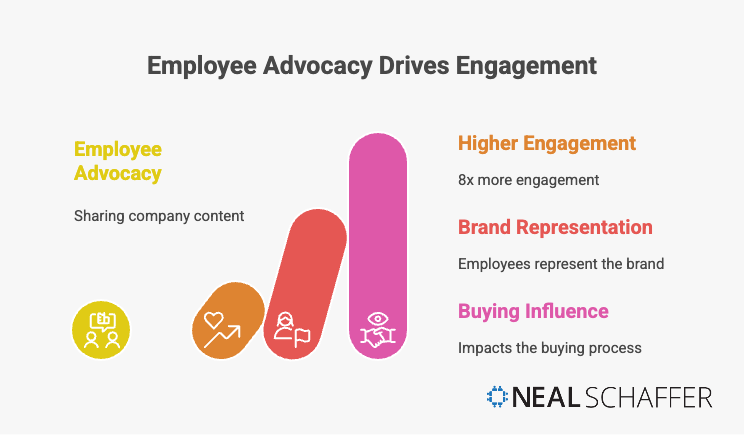
This is something I’ve talked about for more than a decade. You can even see me speak about optimizing social media through employee advocacy at conferences. But employee advocacy is finally evolving from nice-to-have to strategic necessity.
Company content shared by employees gets 8x more engagement than original company posts, according to research compiled by Ambassify.
Successful employee advocacy depends on:
Genuine enthusiasm: Employees sharing content they actually find valuable, not forced promotional material.
Training and support: Helping employees understand effective social media practices and what works on different platforms.
Content access: Making approved content easily available for sharing through dedicated tools or platforms.
Recognition: Acknowledging employees who effectively represent the brand.
In 2026, leading B2B companies will measure employee advocacy impact not just by reach metrics but by engagement quality and influence on the buying process.
What Strategic Content Approaches Work for B2B in 2026?
Content remains the foundation of effective B2B social media marketing, but strategic approaches are evolving significantly. The shift toward first-party data, social SEO optimization, and AI-powered personalization requires new thinking about content creation and distribution.
First-Party Data: Your New Marketing Currency
As privacy regulations tighten and third-party cookies disappear, first-party data becomes essential for effective targeting and personalization. B2B marketers are increasingly using social media to collect this valuable data through interactive content.
91% of B2B marketers report collecting first-party data, according to Content Marketing Institute’s 2026 research. The companies doing this well create genuine value exchanges.
| Data Collection Method | Value to Customer | Value to Business |
|---|---|---|
| Interactive assessments | Personalized insights | Detailed prospect profiles |
| Social media polls/surveys | Community inclusion | Aggregate industry insights |
| Gated premium content | Exclusive high-value information | Contact details and interest areas |
| Social community participation | Peer networking | Behavioral and preference data |
This shift requires B2B marketers to create more valuable content experiences that justify the exchange of information. I’ve written about content creation strategies that work for this purpose.
Social Media SEO Optimization
By 2026, search functionality within social platforms becomes as important as traditional search engines for B2B discovery. Platforms are developing increasingly sophisticated search capabilities.
The connection between social media and overall content strategy continues strengthening. 87% of B2B marketers use blogs specifically for brand awareness, per CMI’s research, and social platforms increasingly surface this content through their search features.
Effective social SEO strategies in 2026 include:
- Keyword research specific to social search: Understanding how people search within LinkedIn, YouTube, and other platforms
- Optimized social profiles: Using relevant terms in bios, descriptions, and about sections
- Strategic hashtag usage: Developing consistent hashtag strategies aligned with search patterns
- Structured content formats: Creating content that matches platform algorithm preferences
Companies that master both traditional SEO and social media SEO create powerful visibility synergies across all discovery channels. Check out my social media marketing statistics for more data on platform-specific optimization.
Where Should You Invest Your B2B Social Media Budget?
B2B marketing budgets are shifting to reflect the increased importance of social media and the specific tactics proving most effective. The data shows clear investment trends that should inform your 2026 planning.
61% of companies are increasing their video content budgets for social media, according to HubSpot. And 40% are investing more in AI technologies for marketing purposes.
B2B Social Media Investment Priorities for 2026
| Investment Area | % Increasing Investment | Expected Primary Benefit |
|---|---|---|
| Video Content | 61% | Engagement and conversion improvement |
| AI Technologies | 40% | Efficiency and personalization at scale |
| LinkedIn Presence | High priority | Professional audience reach, lead generation |
| Employee Advocacy | Growing rapidly | Authentic reach expansion, trust building |
Measuring What Actually Matters
In 2026, measurement frameworks evolve beyond vanity metrics to focus on business impact. This shift reflects the growing maturity of B2B social media as a strategic business function.
When you consider that 80% of B2B leads sourced through social media come from LinkedIn, relationship-based metrics become a critical category of KPIs.
Advanced measurement approaches include:
- Multi-touch attribution models that properly credit social media’s influence on deals
- Relationship development metrics tracking engagement quality over time
- Content effectiveness measures beyond clicks (time spent, sharing behaviors, comments)
- Social selling impact on sales cycle length and deal size
- Platform-specific optimization metrics for maximum algorithm performance
Companies developing sophisticated measurement capabilities gain significant advantages in optimizing their social media investments for maximum business impact.
For a comprehensive view of your current performance, consider using my social media audit checklist.
How Do You Build a Future-Proof B2B Social Media Strategy?
B2B companies need a structured approach to adapting their social media strategies. The pace of change requires both agility and a strong foundation of best practices that can evolve with new developments.
Based on the trends covered here, here’s a framework for developing a strategy that won’t become obsolete:
Platform Strategy: Focus on LinkedIn while strategically expanding to emerging platforms based on where your audience actually spends time.
Content Evolution: Shift toward more video content with platform-appropriate formats and lengths.
Technology Integration: Implement AI tools for both audience targeting and content creation while maintaining human oversight.
Human Element: Develop executive social presence and employee advocacy programs that amplify your reach authentically.
Measurement Transformation: Create frameworks that connect social activities to business outcomes, not just engagement metrics.
Action Plan: What to Do Now
| Area | Next 3-6 Months | 6-18 Months |
|---|---|---|
| Platform Strategy | Audit current performance and audience presence | Develop platform-specific strategies with appropriate resource allocation |
| Content Capabilities | Assess video production capabilities and gaps | Build scalable video creation resources and processes |
| Technology | Evaluate AI tools for immediate efficiency gains | Implement AI across audience targeting and content creation |
| Talent | Identify potential executive thought leaders and employee advocates | Create training and support programs for social media excellence |
For ongoing updates on social media trends, check out my social media trends guide.
LinkedIn remains the dominant platform for B2B marketing, with 96% of B2B marketers including it in their digital strategy. The platform drives approximately 80% of all B2B social media leads. YouTube is the second most important platform, particularly for educational video content.
Most B2B companies are increasing video budgets significantly. 61% of companies report increasing video content investment, with focus on short-form content (30-90 seconds) for LinkedIn and YouTube Shorts, and longer educational content for YouTube and websites.
Yes. Research shows employee-shared content receives 8x more engagement than brand channel posts. 92% of B2B decision-makers engage with sales professionals who position themselves as thought leaders in their industry, making employee advocacy a direct driver of sales opportunities.
75% of B2B buyers now use social media during their purchasing decisions. With millennials and Gen Z comprising 65-73% of B2B decision-makers, expectations have shifted toward short-form video content, authentic engagement, and mobile-first experiences similar to consumer platforms.
AI is becoming integral to B2B social media, with 85% of marketers using AI for content creation. Key applications include predictive audience matching, intent data analysis, real-time content personalization, and campaign optimization. The most effective approaches combine AI efficiency with human strategic oversight and brand voice editing.

The B2B Social Media Opportunity Ahead
The B2B social media environment in 2026 rewards companies that combine technological sophistication with authentic human connections. The trends point to a future where social platforms become even more central to B2B marketing success.
Strategic planning now positions your organization for leadership as these changes accelerate. The companies that will thrive are those that:
- Embrace video as their primary content format across the buyer journey
- Use AI strategically while maintaining authentic human connections
- Develop social selling capabilities across their sales organization
- Build employee advocacy programs that amplify reach and credibility
- Create measurement frameworks connecting social media to business outcomes
The opportunities are real. So are the challenges. But if you start adapting your approach now, you’ll be positioned to lead rather than follow in this transformed environment.
Ready to take your B2B social media strategy to the next level? Contact me about Fractional CMO services for more guidance.
Actionable advice for your digital / content / influencer / social media marketing.
Join 13,000+ smart professionals who subscribe to my regular updates.